Magical Healing Voices

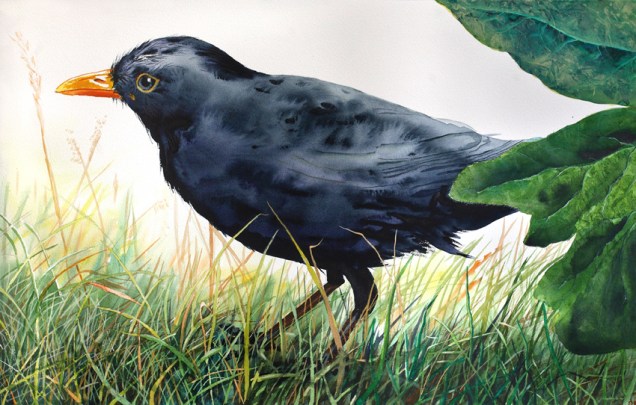
Over 52 weeks I will be learning all about how to live and work creatively. My teachers are Aussie birds and animals. It is week two and the creative force has produced the Common Blackbird to build on the lessons that the Superb Blue Wren initiated.  

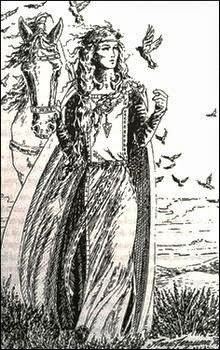
The Welsh Goddess Rhiannon (Great Queen) was accompanied by magical birds whose enchanted songs could ” awaken the dead and lull the living to sleep”. Tadhg, son of Cian, meets the Divine Cliodna, the most beautiful woman in the world. Her three magical birds heal the sick and wounded with their sweet songs. Rhiannon’s birds charmed the company of Bran into losing track of time, in the Welsh legend The Maginogi. Often three birds appear together in Celtic symbolism, an association with the Triple Goddess. Birds often symbolize the flight of the spirits to the otherworld. They possessed supernatural powers, and throughout Celtic mythology, divine entities frequently shape-shift between human and bird form.

Illustration by Anna-Marie Ferguson
showing Rhiannon,
the Celtic Goddess of Birds and Horses,
who may be associated with the Roman
Goddess Epona. Source

Rhiannon is a Welsh Horse Goddess, her name means White Witch or Great Queen.   She is an inspiring figure to invoke for Poets, Artists, and Singers.    She possesses deep magic and can manifest her dreams and desires for the good of all.  She is a good witch, a Healer.  She travels on a powerful white horse with her mysterious birds that possess healing powers.   These birds are magical, for they are the birds of Sweetest Song and she is their mistress.  Rhiannon’s birds appear in various Celtic symbols in Celtic Art.

Rhíannon is a goddess, the princess submerged in cultural darkness who lies like a shadowy creature in the realms of our dreams waiting to come to life with vigour and passion again.

Rhíannon was as patient as she was beautiful.  She was also extremely courageous.   Rhíannon possessed magnificent singing birds which healed with the magical quality of their voices.

Blackbirds are the bird of both the gateway and the forge. Blackbird calls to us from the gateway between two worlds, urging us to follow a spiritual path or to become more self-aware. he calls to us in the twilight, showing us the path to Otherworldly secrets, pointing out the ways in which we can discover more about our hidden motivations and potential. There are times in life when it is important to concentrate on the outer world and your responsibilities in that world, but there are also times when you must attend to the haunting song of your soul which calls you to a study of spiritual truths, and to an exploration of the inner world through dreams and myths. In heeding Blackbird’s song, you will discover healing and new depths in your soul.

Stop to listen and meditate upon the song of the Common Blackbird! Allow the Common Blackbird to do her magic!

Now let Three Birds of Rhiannon songwriter, Stevie Nicks soothe your creative spirit! Play it again and again! Take words and phrases, write them down, work with the words you glean and see what emerges from the inner world.

A Foraging We Go

Over 52 weeks I will be learning all about how to live and work creatively. My teachers are Aussie birds and animals. It is week two and the creative force has produced the Common Blackbird to build on the lessons that the Superb Blue Wren initiated.  

The dictionary describes foraging as a “search for food or provisions.”

Essentially, foraging is the purest and simplest of instincts. The natural reaction to hunger is to seek out food, and before the 24-hour convenience of neatly-arranged supermarket aisles, we scoured the countryside for something, anything, that would sustain us.

Not so many years ago, if you left the house with a wicker basket to harvest food, most people would snigger and point you towards the nearest supermarket. Mushrooming? Heaven forbids; the fungi world was fraught with danger. However, enter celebrity chefs like Jamie Oliver! They have enlightened us about the edible delights that can be found on our doorsteps. Now, any chef worth his or her Michelin salt is foraging or sourcing wild food that sings with natural, integral flavours.

♠ Watch the common blackbird foraging! What are twenty things you observe about the art of foraging?

You might head out with a basket and forage for food or, like me, you might adapt the definition of foraging. For my purposes foraging is the search for food or provisions which will feed my creative spirit! I let my fingers do the walking and under the tutorage of the sharp-eyed blackbird, seek out creative stimuli that will further my creative endeavours. Alternatively, I go to charity stores, second-hand collectable places, libraries, bookshops etc and just see what turns up.

After stumbling upon the Curious Origins of Sing a Song of Sixpence  I was intrigued by where examining a simple nursery rhyme might take me. As the writer of this article says, delving into peoples attempts to find meaning in what was probably a jaunty ditty to amuse children, has been a voyage of learning  in so many ways. How else would we learn about the notorious life of Edward Teach, the medieval splendours of entremet, the lacklustre poet laureate Henry Pye and the larger than life shenanigans of Henry the VIII.

Random Acts of Foraging

The Irish Blackbird, Turdus merula, is a common, resident bird; the males are solid black with a bright orange beak, and the females tend to be brownish in colour (Irish Birds). They are well-known for their abilities as beautiful songsters, and it is because of this trait that they appear often in the literature. ”The ‘Three Birds of Rhiannon’ [a Celtic goddess and queen] were said to have the ability to sing the dead to life, and the living into a sleep of death”, and these birds were also the “harbingers of the Otherworld, and their singing at Harlech in the tale of Branwen suspends earthly time”.  Considering their talents with a song, it comes as no surprise that the Blackbird is generally seen in the role.  In addition, the blackbird’s importance is consistently seen in the native set of symbols as being one of the “Oldest Animals”, in other words, an animal that has been around since the beginning of time, and has learned much about how the world works. Source

Blackbird Fact Sheet

The Story of the White Blackbird  The White Blackbird” is a charming satire on the literary life of Alfred de Musset’s time, exposing not merely the ease with which popular taste is imposed upon and some current types of literary humbugs, but also the universal tendency to confound mere eccentricity with genius.

Three Little Birds” is a song by Bob Marley and the Wailers. It is the fourth track on side two of their 1977 album Exodus and was released as a single in 1980. The song reached the Top 20 in the UK, peaking at number 17. It is one of Bob Marley’s most popular songs.

This happy, upbeat tune tells the tale of three birds who helped remind Bob Marley that “every little thing is gonna be all right.”  Marley died on 11 May 1981 at Cedars of Lebanon Hospital in Miami (now University of Miami Hospital), aged 36. The spread of melanoma to his lungs and brain caused his death. His final words to his son Ziggy were “Money can’t buy life.” In his lifetime he certainly spread his wings and flew! He leaves a rich legacy

https://youtu.be/6i4co3_Jtjk

♠ What does Blackbird help you find! Where does the treasure take you? Feel free to gloat and tell us about any treasure that you find under a leaf!

Sing from an Elevated Perch

Over 52 weeks I will be learning all about how to live and work creatively. My teachers are Aussie birds and animals. It is week two and the creative force has produced the Common Blackbird to build on the lessons that the Superb Blue Wren initiated.  

Blackbirds are known for their melodious voice where they sing from high places such as; rooftops, trees and any other elevated perch. They enjoy standing alone singing and catching the attention of others. Today blackbird is asking us to recognize our creative talent. While this may not be singing, there is a talent that each of us should unhesitatingly express. Rather than hiding our Light under a bushel we need to be singing from the rooftops!

Blackbird inspired The Beatles who wrote a song about him:

Blackbird singing in the dead of night
Take these broken wings and learn to fly
All your life

You were only waiting for this moment to arise
Blackbird singing in the dead of night
Take these sunken eyes and learn to see
All your life
You were only waiting for this moment to be free

Blackbird fly Blackbird fly
Into the light of the dark black night

Blackbird fly Blackbird fly
Into the light of the dark black night

Blackbird singing in the dead of night
Take these broken wings and learn to fly
All your life

You were only waiting for this moment to arise

Today Blackbird is reminding us of the need to celebrate our creative talent, build a firm foundation upon which to create and pay close attention to the details. Blackbird is reminding us to listen to the wisdom of Paul McCartney and Maya Angelou’s And Still I Rise.

Blackbird is encouraging us to repair our broken wings, take the moment to arise and share our inspirational gifts with the world.

A participant in one of my writing courses told me that, I had to keep sharing my gift, that I would be selfish to keep the gift hidden under a bushel! Blackbird has encouraged me to arise, puff out my chest and sing, without inhibition, from an elevated space! I am a gifted purveyor of creative stimuli who has shared inspirational ways to promote creative endeavour. I do this by working on projects like this and by putting together an apothecary (a new form of the Soul Food Cafe) for those who wish to feed the creative spirit.

What will you share with the world?

Valuing One’s Unique Identity

Over 52 weeks I will be learning all about how to live and work creatively. My teachers are Aussie birds and animals. It is week one and the creative force has produced the Superb Blue Wren to provide some lessons!

“The Arrernte word Awelye, from Central Australia, describes the interrelationship of everything; plant, animal, earth and language. Aboriginal knowledge about plants, animals, non-living things, spirit, economy, aesthetics, kin, responsibility and journeying bind types of information with one another.

In other words, everything informs us about everything else and nothing can be considered in isolation. By contrast, non-indigenous knowledge structures involve hierarchical and increasing separation of information into ever smaller parts for detailed examination. Aboriginal knowledge stems from the practical experience of natural resources. Like all people that live with and close to the land, they have developed an understanding of the interrelationships between ecological functions and broader patterns in climate and geophysical features. Understanding and learning the signals of change is indicative of the depth of knowledge that Aboriginal people have achieved.

Totems are a significant symbol of Aboriginal people’s inextricable link to the land. Aboriginal people gave recognition to the power of the plant and animal spirits by wearing skins and masks of ceremonial paint, and by mimicking, singing praise and dedicating prayers to specific plants and animals.

They painted and engraved them in caves, rock overhangs and on rock platforms, on bark and burial trees and asked Mirrirul4 to guide them to plant and animal foods and to bless the spirit of the plant or animal that was killed. These acts allowed people to remain linked to the plant and animal guides and to accept the power they offer in lessons, in life, and in death. It reminded people that all animals are our sisters, brothers, and cousins and most importantly our teachers and our friends.” Source:  Murni Dhungang Jirrar Living in the Illawarra

The Ngarrindjeri people of the Murray River and Coorong regions called the Blue Fairy-Wren, waatji pulyeri, meaning “little one of the waatji (lignum) bush”, and the Gunai called it deeydgun, meaning “little bird with long tail”.  Both it and the variegated fairywren were known as muruduwin to the local Eora and Darug inhabitants of the Sydney basin.

This Aboriginal Dreaming story about waatji pulyeri (blue fairy-wren) reminds us that while we are all interconnected we each have unique characteristics. It also cautions the creative of the dangers of engaging in competitions to prove one’s worth! We are reminded that individuality is a very important part of our identity. Blue Wren’s story tells the creative that they do not need to engage in a competition. They only have to be their unique self!


Courting the Creative Spirit

Over 52 weeks I will be learning all about how to live and work creatively. My teachers are Aussie birds and animals. It is week one and the creative force has produced the Superb Blue Wren to provide some lessons!

Of all the facts about the Superb Fairy-wren’s life that have been discovered over the years, none is more charming than one small detail of the male’s courtship behaviour. While wooing a potential mate, either in his territory or in somebody else’s, a male Superb Fairy-wren will pluck petals from a flower and present them to the female as a kind of bouquet.

Males are also known for the ‘seahorse flight’, named for its seahorse-like undulations, during which the male—with his neck extended and his head feathers erect—tilts his body from horizontal to vertical, and descends slowly and springs upwards by rapidly beating his wings after alighting on the ground. The ‘face fan’ display is also noted as a part of sexual display behaviours; it involves the flaring of the blue ear tufts by erecting the feathers.

Whether this increases his chances of mating or not is hard to know; but it’s hard not to smile at the thought of this tiny, colourful bird carrying such an offering.

Artists who court the muse want to tap into that mysterious source of artistic inspiration all creative people seek. They search for a more knowing, more spiritual inner wisdom – something inside or even outside themselves that will inspire and inform their art. That inspirational, essential wisdom points the way inward, toward the emotions, the psyche, the soul. It calls upon us to cultivate a healthy relationship with the deep well of creative mystery that lies within.

What ritualistic displays might you devise to court and nurture the creative spirit? How will you use the reflective faculty we have within?

“Discipline is very important. I think we’re creative all day long. We have to have an appointment to have that work out on the page. Because the creative part of us gets tired of waiting, or just gets tired.” — Mary Oliver

“If Romeo and Juliet had made their appointments to meet, in the moonlight-swept orchard, in all the peril and sweetness of conspiracy, and then more often than not failed to meet — one or the other lagging, or afraid, or busy elsewhere — there would have been no romance, no passion, none of the drama for which we remember and celebrate them. Writing a poem is not so different—it is a kind of possible love affair between something like the heart (that courageous but also shy factory of emotion) and the learned skills of the conscious mind. They make appointments with each other, and keep them, and something begins to happen. Or, they make appointments with each other but are casual and often fail to keep them: count on it, nothing happens.

The part of the psyche that works in concert with consciousness and supplies a necessary part of the poem — the heart of the star as opposed to the shape of a star, let us say — exists in a mysterious, unmapped zone: not unconscious, not subconscious, but cautious. It learns quickly what sort of courtship it is going to be. Say you promise to be at your desk in the evenings, from seven to nine. It waits, it watches. If you are reliably there, it begins to show itself — soon it begins to arrive when you do. But if you are only there sometimes and are frequently late or inattentive, it will appear fleetingly, or it will not appear at all.” Mary Oliver

♥ Make an appointment with the creative spirit today! It is enough to just hang out together!

♥ Visit Contemporary Aboriginal Artist, Mirree and learn about how Wren Dreaming can help nurture your creative spirit. Perhaps you will treat the creative spirit to some of Mirree’s beautiful Oracle Cards and her Dreamtime Colouring Book. I use a deck like this to determine who will be the next animal to enter my space and insist that their voice be heard.

Singing Over Our Creative Eggs

Over 52 weeks I will be learning all about how to live and work creatively. My teachers are Aussie birds and animals. It is week one and the creative force has produced the Superb Blue Wren to provide some lessons!

Mothers usually set about teaching their offspring the moment they’re born. But the females of this  Australian bird can’t wait that long. Researchers discovered, by accident, while recording at fairy-wren domed nests, that female fairy-wren were singing to their eggs.

The females of superb fairy-wren (Malurus cyaneus) start singing to their unhatched eggs in order to teach the embryo a “password,” a single unique note, which nestlings must later incorporate into their begging calls in order to get fed. This trick allows fairy-wren parents to distinguish between their own offspring and those of cuckoo species that invade their nests. The females also teach the pass-note to their mates. This has the potential of opening up new lines of inquiry into prenatal learning systems.

In her book, Women Who Run With the Wolves, Clarissa Pinkola Estes talks about singing over the bones to feed the creative spirit. As an artistic midwife I am familiar with the creative birthing process, but until the blue wren flitted into my world I had not thought of encouraging creatives to “sing over their eggs’

A Sensory Aussie Bird Garden

When I bought my home in Castlemaine, seven years ago, the backyard had a few established plants but it was a harsh, unwelcoming environment. A new home was being built directly behind me and, being on a rise, my new deck overlooked theirs. I laughed and told them not to worry because I would soon obscure the view. I announced that soon there would be a woodland out there. Everyone was sceptical, but the woodland has materialized, and it is the home to many birds. I have created a green corridor!

Adjoining neighbours have both thanked me for creating this leafy space because they have both noticed the appearance of the superb fairy blue wrens, a bird that as ‘Birds Backyards’ says, needs protecting.

It is not actually easy being blue because the wren has to spend a lot of time watching for predators. However, the superb Blue Wren is at home where ever they are. They are charismatic songbirds who live in groups. They move about jauntily foraging for insects and larvae while maintaining their territories and use the energy of their little community to protect their territory and be aware of any danger. They teach you in how to be resourceful, let go and use flexibility when faced with intrusion or find opposition in life. They ask you, is it time to shift the way you are thinking and allow a change of perspective. (Source: Peacespace)

The Twelve Days of Christmas featuring Australian birds and animals is just one of my ways of helping Aussie birds and animals! Over the coming year, I am planning to spend more time playing, observing and raising awareness of the wisdom they have to offer the creative person.

Over 52 weeks I will be learning all about how to live and work creatively. My teachers are  Aussie birds and animals. This week the creative force has produced the Superb Blue Wren to provide some lessons!

What can you do to help native bird life?