Forest Creek Historic Gold diggings is situated mid-way between Castlemaine and Chewton. This historic mining site is in the Castlemaine Diggings National Heritage Park, and there is to do free of charge. A 400-metre walk allows you to discover how miners won gold from Forest Creek. The walk commences at a small shed below which is a dam.The dam has clean beach and is a great place to learn to pan for gold. At the waters edge you will find gravel which has been put there for you to try your luck at panning.


The Forest Creek Diggings caused quite a stir in 1851. As more and more newcomers pegged their claims, they followed the deposits of gold up the eroded flats and valleys feeding the creek. It soon dawned on the crowd that gold washed into the river flats came from the surrounding rises.
In March of 1852, White Hill was the scene of a rush within a rush, and a month later the adjacent rise known as Red Hill was swarming with hopefuls, some lying stretched out on the ground to secure their eight foot by eight foot claim (about two metres by two metres).
Today, the Forest Creek Gold Diggings occupies the remains of White Hill and Red Hill. There have been nearly 150 years of continuous mining here, and a remarkable range of techniques has been used to extract the alluvial (river deposited) gold. All of these techniques were versions of the panning process, whereby clay and gravel are washed away from the heavier gold, and all have left their traces.
At first, miners of the 1850s dug shafts through the layers of the ancient riverbed, and carried gravel and clay to the creek below to be washed in pans or wooden ‘cradles’.
Sometimes miners digging a shaft would be tricked by a layer of sediment `as hard as the pyramids’, and abandon their shaft before reaching richer deposits below. A number of 1850s shafts remain on White Hill today.
Later mining methods included puddling, a process of washing and working clay to release fine particles of gold. This could either be done by hand in a small trough, or with the help of a horse working a large circular puddling trough. In times of abundant water, surfacing was practised. It was a process of flooding the surface of a hill to remove the gold-bearing topsoil, and directing the flow through a series of barriers, known as a ground sluice, to collect the gold. Source: Friends of Mount Alexander Diggings
 The Forest Creek Geo Maze is constructed from eight concentric circles of rocks. The six types of rocks are representative of the main periods of geological activity in the goldfields region. The oldest rocks are placed around the outer circle and the younger rocks are in the centre.


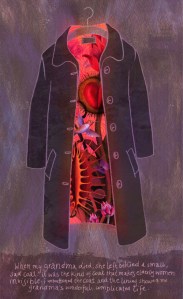 I have always been fascinated by Clarissa Pinkola Estes idea of making a full length scapecoat to detail one’s scars in painting, writing, with all manner of things pinned and stitched inside. It is the perfect place to pin all that one has endured, “all the insults, the slurs, all the traumas, all the wounds”. Such a coat is a way of visually portraying one’s endurance and the victory of still standing tall.


 This old yellow box has nothing to say to me about the insanity of the gold fever that bought hoards here and even less about the people who lived in the nearby ruins. But maybe, if I come visiting often enough, he might just reveal something about how to live alone through times of loss and change.


 A working dog is a canine working animal, i.e., a type of dog that is not merely a pet but learns and performs tasks to assist and/or entertain its human companions, or a breed of such origin. In Australia and New Zealand, a working dog is one which has been trained to work livestock, irrespective of its breeding. Truffle hunting dogs, for example, are

 This lot are reputed to be skilled at herding reindeer but with few reindeer in these parts they do not have to work – unless you count maintaining vigilant watch of property boundaries as work. No one gets onto the property without me knowing and they do provide companionship and even comfort when they perceive it is needed!


 While Waiting For Godot