Piggiebillah the Echidna was once a man. When he grew old, so old that all his friends had died, he lived with men who had been boys when he was middle-aged. They were all strong and tireless, and able to hunt all through the hot sunny hours of the day, and to travel long distances in search of food, but Piggiebillah was too old to take his part in providing food for the tribe.
No-one gave him anything to eat, and it was surprising that he remained so well. As he grew older he seemed better nourished than anyone else. In fact it was so very surprising that some of the people became suspicious and kept a close watch on him. After some time they discovered something that Piggiebillah had kept a secret to himself for years.
When he left the camp one morning, he was followed, and it was seen that he went to a rock at some distance from the encampment, and hid in its shadow. The watchers peered at him from behind bushes, wondering what he was waiting for. They soon found out. A young woman came along the path. Piggiebillah sprang out, and before anyone could move or give a shout of warning, he plunged his spear into her body. The old man dragged her off the track, ate her limbs, and hid the rest of her body away for a later meal.
The disappearance of many people of their tribe, and of visitors who were expected and never arrived, was at last explained. A secret meeting was held and it was unanimously decided that Piggiebillah must be killed. He was so active, in spite of his great age, that he had to be taken unawares.
They waited until there was a dark night without a moon. The old man was lying at some distance away from the fire. The men gathered silently round him. He was sleeping on his back with his mouth shut to prevent his spirit from wandering. He moved in his sleep and murmured, ‘I hear the butterflies stamping in the grass.’
While he dreamed of butterflies the men drove their spears into his body. Piggiebillah groaned as they beat him with their clubs. Bone after bone in his body and arms and legs was broken, and at last the terrible cannibal lay still.
His wife was looking on in horror. She hit her head with her digging stick until the blood ran over her breast. Her name was Guineeboo, and when she fled from the scene she became Guineeboo, the Red-breasted Robin.
The men crowded round the fire, laughing and chattering over their easy victory. But Piggiebillah was not dead. He dragged himself painfully into the deeper shadows until he came to the burrow of Trapdoor Spider, Murga Muggai. He fell down the hole, and stayed at the bottom until his wounds were healed.
The one thing he could not do was to pull the spears out of his body, nor did the bones in his broken limbs knit together. Nobody recognised Piggiebillah when he came out into the daylight again. He crawled on all fours, with his broken legs splayed out, and the spears were a bristling forest on his back. For food he dug with his hands, and had to be satisfied with ants and other insects, and scraps of food.
Piggiebillah had turned into an Echidna, the little animal that scratches for ants because he cannot eat other food, and burrows underground to escape from his enemies.
Over 52 weeks I will be learning all about how to live and work creatively. My teachers are Aussie birds and animals. It is week five and the creative force has produced the Pelican to build on the lessons that Australian birds, animals and habitat are initiating.
After watching a Pelican, patiently perched on its nest at St Leonard’s, Victoria, on the Australia Day long weekend I have been encouraged to emulate this bird. Ted Andrews talks about Still-hunting in this classic book, Animal-Wise.
“Still-hunting was practised in shaman traditions all over the world. Its primary purpose is to observe and learn. The still-hunter would go to a place he or she knew well or felt attracted to, whether a hillside, a meadow, a forest or a pond. There the individual would wait patiently until everything returned to normal. Then the still-hunter opens themselves to learn from the natural world.”
A google search reveals that this term is also used by actual hunters who treat the killing of animals as a sport! As a consequence, I will be using the term still-observing!
Perched on the nest my pelican, photographed here, appeared to be still-observing!
Become a still-observer!
Let the place choose you! It may be your own backyard!
Allow intuition to guide you to a place.
Upon arriving in the place become as unobtrusive to the environment as possible.
Remain very still and observe. Let the world go around you as if it were not there.
Feel and imagine yourself as a part of the environment and natural surroundings
Quietly observe the sounds! Pay attention to small detail.
Over 52 weeks I will be learning all about how to live and work creatively. My teachers are Aussie birds and animals. It is week five and the creative force has produced the Pelican to build on the lessons that Australian birds, animals and habitat are initiating.
The elegant pelican animal totem is definitely an opportunist with style and finesse. In the wild, these large-billed birds perch themselves in the most advantageous position before swooping in to catch their prey. They wait patiently and focus intently, striking at the most perfect moment.
Pelican spirit guides float into our awareness to encourage us to do the same. In order to experience the benefits of opportunities, we must be proactive. We cannot just sit idly and wait for things to come our way all of the time. Each of us needs to get out there and place ourselves in circumstances that will yield benefits. Put yourself in a position that will enable you to utilize skills and resources.
In addition to resourcefulness, the pelican spiritual totem commonly symbolizes social responsibility and active attributes, such as social, teamwork, charity, generosity and friendliness. This is because these birds are highly social and reliant upon their groups. Hunting is a group effort, in which many members of the flock work together to gain abundance. Pelicans encourage us to develop friendly, caring, and supportive relationships with members of our own communities, as well.
Are you intent upon a goal, or some treasure you desire? Do like the pelican does. Perch yourself in an advantageous position, and observe the resources that come your way.
The Djargurd Wurrong possum skin cloak was worn by Gunditjmara Elder Ivan Couzens at the Opening Ceremony of the 2006 Melbourne Commonwealth Games. The cloak was made by Vicki Couzens and Yarran, Jarrah, Marlee, Niyoka and Kirrae Bundle. Gunditjmara, Western District of Victoria. River people.
A dreaming story tells of a confrontation between the Rock Wallaby Men from Port Agusta and the northern Possum Men. The Possum Men were conducting important ceremonies when the Rock Wallabies burst in and a fight broke out. Eventually, the two sides called an end to the fighting and agreed to exchange the important ceremonial knowledge. They established a big corroboree camp and the country surrounding was known as good possum country before the arrival of the white settlers. In fact, Aboriginal law completely protects some of these sites from hunting, even during drought, in order to ensure the survival of their food species. Unfortunately, possums have almost completely disappeared from this region although they are still very important in the dreaming songs and rituals performed today. Source
Possum has come to remind us that no one can own the stars; that the creative force is responsive when we share and take active steps to protect the source of creativity.
The Djargurd Wurrong possum skin cloak, worn by Gunditjmara Elder Ivan Couzens at the Opening Ceremony of the 2006 Melbourne Commonwealth Games, is an example of what happens when artistic people work collaboratively, rather than keeping their important ceremonial knowledge to themselves. Elder, Ivan Couzens, and others talk about how the cloak helps Aboriginals understand who they are.
They talk with their beaks full of blossom
In a cascade of chatter as they sidle
Invisibly through the swaying treetops
They fly in a hurry as if all the gumnuts
Would disappear before they got to them
Geoffrey Dutton
Musk Lorikeets have been feeding on the fruit in my yard, hurling stone fruit onto the roof of the galvanised shed that the fruit tree spreads its branches over. The ground is covered with kernels, hastily discarded as the birds flit off looking for the next treat! These joyful creatures bring brightly coloured plumage and comic antics into my world.
The Rainbow Lorikeet and Musk Lorikeet have inspired rich poetic characterisations, with poets depicting them as gangs of unruly, chattering, aerodynamic, comical bandits. Geoffrey Dutton and Mark O’Connor are just two Australian poets who personify the spirit of these free-ranging, social creatures.
Lorikeets are full of silliness and humour, and they are also inquisitive about their surroundings. They remind the writer and artist to bring colour, humour and light into their work.
Manuel Payno is a writer whose work brought as much joy as a flock of lorikeets. In the translator’s preface, Alan Fluckey describes the small riot that erupted when a ship, carrying copies of The Bandits from Rio Frio in its cargo, arrived in Mexico. Boxes were hastily opened and copies were sold within minutes as people greedily hustled to get their own personal copy. Book in hand Mexicans sat about in the open air reading to their neighbours! Rainbow chatter filled the air!
Lorikeet and Payno come whirling into my world, reminding me to remind everyone to be exuberant and add colour to their writing; to write and paint about colourful places and colourful characters! Examine the work of Payno closely! Combine this with a copy of The Donkey Inside by Ludwig Bemelmans! Your work will be enriched!
Rainbow Lorikeets
by Mark O’Connor
To feed head-down in an aerial smother of honey and pollen
reassured by a rainbow chatter of siblings
changing tree on impulse
in case python or man is stalking,
reckless till then . . .
A frantic pillaging crew,
crimson-patched pirates screeching in plunder-frenzy,
ignoring the silver-eyes nervously feeding
under those orange scimitars of beak.
The first dozen leave in a second, headlong, a rapid
scatter of downward notes; greedy last tilts his head
and is traumatised by a blank grey-green
widowed of reds and orange.
Before long they’ll circle back.
Shrieks of “Saps up”, “Feed here!”,
churrs of “All’s well, Honey flows”,
screech of “Hawk’s shadow! Watch out!”
mute to the mating thrum
Bill-and-Coo, Tickle-and-Tweek.
Their world is millions of honey-dripping pores.
Free as a child with a million breasts to suckle,
the world’s glands, daytime and night,
at work making sweets for them.
“Comic book bandidos”, but equally
rainbow-motley clowns; with their walk-claws
they tread-cling, wading and stumbling
up loose sprays of blossom
as a lily-trotter walks floating weeds.
They clutch-bunch and jostle on rafts of leaf
buoyed there by bough-spring, then flare out
over forests where the tenth tree in rotation
is an oasis of dripping pompoms.
Their brush-tongues delving and combing
bully honey from bottle-brush florets
or bite them off short,
munching sweet mash.
This desert of unfruiting trees,
deluding the settlers with woody semblances,
is their land of nectar and pollen-bread, antipodean
paradise, where raucous workers thrive.
A good tree gives gallons a day
— but modestly, from flowers as dull as grasses,
pale cream or off-white, blanched foliage.
Birds themselves must play petal;
their stridulous yellows and blues and orange and red
flag out each tree of delights, proclaim the loud shrines
of fermenting, honeyed, winey abundance.
It is said the birds came from dinosaurs.
Rainbow dinosaurs.
Some Colourful Characters Who Populated Lemuria
Heather Blakey 2004 – 10
Over 52 weeks I will be learning all about how to live and work creatively. My teachers are Aussie birds and animals. It is week two and the creative force has produced the Common Blackbird to build on the lessons that the Superb Blue Wren initiated.
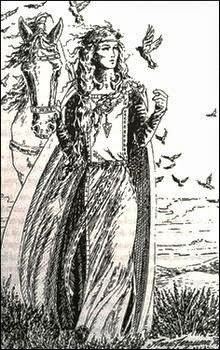
The Welsh Goddess Rhiannon (Great Queen) was accompanied by magical birds whose enchanted songs could ” awaken the dead and lull the living to sleep”. Tadhg, son of Cian, meets the Divine Cliodna, the most beautiful woman in the world. Her three magical birds heal the sick and wounded with their sweet songs. Rhiannon’s birds charmed the company of Bran into losing track of time, in the Welsh legend The Maginogi. Often three birds appear together in Celtic symbolism, an association with the Triple Goddess. Birds often symbolize the flight of the spirits to the otherworld. They possessed supernatural powers, and throughout Celtic mythology, divine entities frequently shape-shift between human and bird form.
Illustration by Anna-Marie Ferguson showing Rhiannon, the Celtic Goddess of Birds and Horses, who may be associated with the Roman Goddess Epona. Source
Rhiannon is a Welsh Horse Goddess, her name means White Witch or Great Queen. She is an inspiring figure to invoke for Poets, Artists, and Singers. She possesses deep magic and can manifest her dreams and desires for the good of all. She is a good witch, a Healer. She travels on a powerful white horse with her mysterious birds that possess healing powers. These birds are magical, for they are the birds of Sweetest Song and she is their mistress. Rhiannon’s birds appear in various Celtic symbols in Celtic Art.
Rhíannon is a goddess, the princess submerged in cultural darkness who lies like a shadowy creature in the realms of our dreams waiting to come to life with vigour and passion again.
Rhíannon was as patient as she was beautiful. She was also extremely courageous. Rhíannon possessed magnificent singing birds which healed with the magical quality of their voices.
Blackbirds are the bird of both the gateway and the forge. Blackbird calls to us from the gateway between two worlds, urging us to follow a spiritual path or to become more self-aware. he calls to us in the twilight, showing us the path to Otherworldly secrets, pointing out the ways in which we can discover more about our hidden motivations and potential. There are times in life when it is important to concentrate on the outer world and your responsibilities in that world, but there are also times when you must attend to the haunting song of your soul which calls you to a study of spiritual truths, and to an exploration of the inner world through dreams and myths. In heeding Blackbird’s song, you will discover healing and new depths in your soul.
Stop to listen and meditate upon the song of the Common Blackbird! Allow the Common Blackbird to do her magic!
Now let Three Birds of Rhiannon songwriter, Stevie Nicks soothe your creative spirit! Play it again and again! Take words and phrases, write them down, work with the words you glean and see what emerges from the inner world.
Over 52 weeks I will be learning all about how to live and work creatively. My teachers are Aussie birds and animals. It is week two and the creative force has produced the Common Blackbird to build on the lessons that the Superb Blue Wren initiated.
Blackbirds are known for their melodious voice where they sing from high places such as; rooftops, trees and any other elevated perch. They enjoy standing alone singing and catching the attention of others. Today blackbird is asking us to recognize our creative talent. While this may not be singing, there is a talent that each of us should unhesitatingly express. Rather than hiding our Light under a bushel we need to be singing from the rooftops!
Blackbird inspired The Beatles who wrote a song about him:
Blackbird singing in the dead of night
Take these broken wings and learn to fly
All your life
You were only waiting for this moment to arise
Blackbird singing in the dead of night
Take these sunken eyes and learn to see
All your life
You were only waiting for this moment to be free
Blackbird fly Blackbird fly
Into the light of the dark black night
Blackbird fly Blackbird fly
Into the light of the dark black night
Blackbird singing in the dead of night
Take these broken wings and learn to fly
All your life
You were only waiting for this moment to arise
You were only waiting for this moment to arise
You were only waiting for this moment to arise
Today Blackbird is reminding us of the need to celebrate our creative talent, build a firm foundation upon which to create and pay close attention to the details. Blackbird is reminding us to listen to the wisdom of Paul McCartney and Maya Angelou’s And Still I Rise.
Blackbird is encouraging us to repair our broken wings, take the moment to arise and share our inspirational gifts with the world.
A participant in one of my writing courses told me that, I had to keep sharing my gift, that I would be selfish to keep the gift hidden under a bushel! Blackbird has encouraged me to arise, puff out my chest and sing, without inhibition, from an elevated space! I am a gifted purveyor of creative stimuli who has shared inspirational ways to promote creative endeavour. I do this by working on projects like this and by putting together an apothecary (a new form of the Soul Food Cafe) for those who wish to feed the creative spirit.
Over 52 weeks I will be learning all about how to live and work creatively. My teachers are Aussie birds and animals. It is week one and the creative force has produced the Superb Blue Wren to provide some lessons!
“The Arrernte word Awelye, from Central Australia, describes the interrelationship of everything; plant, animal, earth and language. Aboriginal knowledge about plants, animals, non-living things, spirit, economy, aesthetics, kin, responsibility and journeying bind types of information with one another.
In other words, everything informs us about everything else and nothing can be considered in isolation. By contrast, non-indigenous knowledge structures involve hierarchical and increasing separation of information into ever smaller parts for detailed examination. Aboriginal knowledge stems from the practical experience of natural resources. Like all people that live with and close to the land, they have developed an understanding of the interrelationships between ecological functions and broader patterns in climate and geophysical features. Understanding and learning the signals of change is indicative of the depth of knowledge that Aboriginal people have achieved.
Totems are a significant symbol of Aboriginal people’s inextricable link to the land. Aboriginal people gave recognition to the power of the plant and animal spirits by wearing skins and masks of ceremonial paint, and by mimicking, singing praise and dedicating prayers to specific plants and animals.
They painted and engraved them in caves, rock overhangs and on rock platforms, on bark and burial trees and asked Mirrirul4 to guide them to plant and animal foods and to bless the spirit of the plant or animal that was killed. These acts allowed people to remain linked to the plant and animal guides and to accept the power they offer in lessons, in life, and in death. It reminded people that all animals are our sisters, brothers, and cousins and most importantly our teachers and our friends.” Source: Murni Dhungang Jirrar Living in the Illawarra
The Ngarrindjeri people of the Murray River and Coorong regions called the Blue Fairy-Wren, waatji pulyeri, meaning “little one of the waatji (lignum) bush”, and the Gunai called it deeydgun, meaning “little bird with long tail”. Both it and the variegated fairywren were known as muruduwin to the local Eora and Darug inhabitants of the Sydney basin.
This Aboriginal Dreaming story about waatji pulyeri (blue fairy-wren) reminds us that while we are all interconnected we each have unique characteristics. It also cautions the creative of the dangers of engaging in competitions to prove one’s worth! We are reminded that individuality is a very important part of our identity. Blue Wren’s story tells the creative that they do not need to engage in a competition. They only have to be their unique self!
Over 52 weeks I will be learning all about how to live and work creatively. My teachers are Aussie birds and animals. It is week one and the creative force has produced the Superb Blue Wren to provide some lessons!
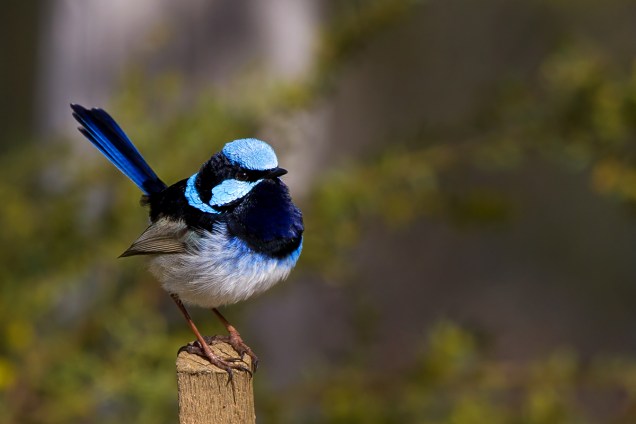
Of all the facts about the Superb Fairy-wren’s life that have been discovered over the years, none is more charming than one small detail of the male’s courtship behaviour. While wooing a potential mate, either in his territory or in somebody else’s, a male Superb Fairy-wren will pluck petals from a flower and present them to the female as a kind of bouquet.
Males are also known for the ‘seahorse flight’, named for its seahorse-like undulations, during which the male—with his neck extended and his head feathers erect—tilts his body from horizontal to vertical, and descends slowly and springs upwards by rapidly beating his wings after alighting on the ground. The ‘face fan’ display is also noted as a part of sexual display behaviours; it involves the flaring of the blue ear tufts by erecting the feathers.
Whether this increases his chances of mating or not is hard to know; but it’s hard not to smile at the thought of this tiny, colourful bird carrying such an offering.
Artists who court the muse want to tap into that mysterious source of artistic inspiration all creative people seek. They search for a more knowing, more spiritual inner wisdom – something inside or even outside themselves that will inspire and inform their art. That inspirational, essential wisdom points the way inward, toward the emotions, the psyche, the soul. It calls upon us to cultivate a healthy relationship with the deep well of creative mystery that lies within.
What ritualistic displays might you devise to court and nurture the creative spirit? How will you use the reflective faculty we have within?
“Discipline is very important. I think we’re creative all day long. We have to have an appointment to have that work out on the page. Because the creative part of us gets tired of waiting, or just gets tired.” — Mary Oliver
“If Romeo and Juliet had made their appointments to meet, in the moonlight-swept orchard, in all the peril and sweetness of conspiracy, and then more often than not failed to meet — one or the other lagging, or afraid, or busy elsewhere — there would have been no romance, no passion, none of the drama for which we remember and celebrate them. Writing a poem is not so different—it is a kind of possible love affair between something like the heart (that courageous but also shy factory of emotion) and the learned skills of the conscious mind. They make appointments with each other, and keep them, and something begins to happen. Or, they make appointments with each other but are casual and often fail to keep them: count on it, nothing happens.
The part of the psyche that works in concert with consciousness and supplies a necessary part of the poem — the heart of the star as opposed to the shape of a star, let us say — exists in a mysterious, unmapped zone: not unconscious, not subconscious, but cautious. It learns quickly what sort of courtship it is going to be. Say you promise to be at your desk in the evenings, from seven to nine. It waits, it watches. If you are reliably there, it begins to show itself — soon it begins to arrive when you do. But if you are only there sometimes and are frequently late or inattentive, it will appear fleetingly, or it will not appear at all.” Mary Oliver
♥ Visit Contemporary Aboriginal Artist, Mirree and learn about how Wren Dreaming can help nurture your creative spirit. Perhaps you will treat the creative spirit to some of Mirree’s beautiful Oracle Cards and her Dreamtime Colouring Book. I use a deck like this to determine who will be the next animal to enter my space and insist that their voice be heard.
Over 52 weeks I will be learning all about how to live and work creatively. My teachers are Aussie birds and animals. It is week one and the creative force has produced the Superb Blue Wren to provide some lessons!
Mothers usually set about teaching their offspring the moment they’re born. But the females of this Australian bird can’t wait that long. Researchers discovered, by accident, while recording at fairy-wren domed nests, that female fairy-wren were singing to their eggs.
The females of superb fairy-wren (Malurus cyaneus) start singing to their unhatched eggs in order to teach the embryo a “password,” a single unique note, which nestlings must later incorporate into their begging calls in order to get fed. This trick allows fairy-wren parents to distinguish between their own offspring and those of cuckoo species that invade their nests. The females also teach the pass-note to their mates. This has the potential of opening up new lines of inquiry into prenatal learning systems.
In her book, Women Who Run With the Wolves, Clarissa Pinkola Estes talks about singing over the bones to feed the creative spirit. As an artistic midwife I am familiar with the creative birthing process, but until the blue wren flitted into my world I had not thought of encouraging creatives to “sing over their eggs’
Over 52 weeks I will be learning all about how to live and work creatively. My teachers are Aussie birds and animals. It is week one and the creative force has produced the Superb Blue Wren to provide some lessons!
Andrew Katsis, who spent two years of a Masters studying the fairy-wren, reveals that there is much more to this striking bird than meets the eye. He explains that they live in cooperative family groups (in which sons – but not daughters – hang around to help raise their younger siblings), learn vocalisations from their mother while still inside the egg, and boast perhaps the highest rate of adultery in the bird kingdom.
One intriguing finding of a Geelong study was that being more exploratory affected a bird’s survival chances. Fast- explorers were less likely to be present in the population a year later, most likely because they had died. The researchers speculated that fast- explorers are perhaps less wary of potential threats and more likely to stray into the sights of predators.
One cannot help but ask why this variation exist at all? You might think that natural selection would quickly weed out all the fast- explorers? This is a question the research group are working on. One possible explanation is that birds with different personalities facilitate each other by performing different social roles (known as social niche specialisation). Fast- explorers may be filling a separate social niche that achieves equal reproductive fitness despite their shorter lifespan.
Today the fairy-wren encourages us to consider how we work, to consider our creative niche specialisation! Fairy-wren asks us to consider how we pace ourselves? Fast- exploring animals tend to form routines more quickly, and therefore thrive in consistent environments. Slow- exploring animals are better able to respond to changes in their environment, which may be beneficial in a fluctuating habitat.
Take the time to consider your social niche specialisation and the routine that works best for you!
Sometimes, when I need fuel injected creativity, I turn to a Tarot deck. This deck is far from complete, but there are some stories lying behind my version of the Tarot. 2010 was a traumatic year for me so there were many swords appearing in my drawings. Heather Blakey Pencil Drawings 2010
According to the definition provided by Hussein, a sensory garden is a garden where all components are carefully designed to provide maximum sensory stimulation (2011). The aim of these gardens is to heighten our awareness of our interaction with nature through our senses. This definition of a sensory garden encompasses awareness of all aspects of the garden, both vegetative and hardscape elements. The hardscape elements to be included in therapeutic gardens, including sensory gardens, are as important as the vegetative elements because they become an integral part of the overall experience. For example, paths, walls, seating and signage all allow access, inclusivity and interactivity within the garden. From Therapeutic Gardens
Since moving to this home in 2010 I have worked intuitively, using my senses, to create two quite distinct gardens. The front garden has elements of what Nana would have planted in her 1960’s garden while the exposed, harsh backyard has been transformed into a woodland that attracts a rich variety of birdlife.
Bush songs devised by ordinary, everyday people are a record of the people’s experiences of living, surviving and dying in the bush, as well as the colourful slang of bush life.
Today, on my way back from meeting a friend at Malmsbury for lunch, I saw a sign, that I had never noticed before, pointing to the Elphinstone Cemetery. It was quite a trek, along an unsealed road, to find this well maintained old cemetery. At the time when it was established in Elphinstone, there would have been more bush to be seen. Today you pass by properties on acreage!
What is it about ‘the bush’ that is so special to Australians? The bush has an iconic status in Australian life and features strongly in any debate about national identity, especially as expressed in Australian literature, painting, popular music, films and foods.
The bush was something that was uniquely Australian and very different to the European landscapes familiar to many new immigrants. The bush was revered as a source of national ideals by the likes of Henry Lawson and Banjo Paterson. Romanticising the bush in this way was a big step forward for Australians in their steps towards self-identity. The legacy is a folklore rich in the spirit of the bush.
Many Australian myths and legends have emanated from the bush. Early bushranging – ranging or living off the land – was sometimes seen as a preferred option to the harsh conditions experienced by convicts in chains. Later bushrangers such as Jack Donohue, Ben Hall and Ned Kelly were seen as rebellious figures associated with bush life. Their bushmanship was legendary as well as necessary. Source: The Australian Bush
In the first few years of the colony, mortality was very high, but the common childhood infections were absent until the 1830s. From the 1880s, there was a sustained decline in mortality from communicable diseases, and therefore in aggregate mortality, while maternal mortality remained high.
Some details included with photos.
The squares upon which the cross is mounted record the deaths of three children. John died in 1911, aged 12. Ellen drowned in 1918 aged 9 and Mary died at 12, cause not listed.
A moving family monument at Sandon, Victoria. Parents buried alongside children who pre-deceased them.
Vaughan Cemetery! While the parents lived to an old age they lost three children.
Note the death of Mary at 24 and her two children aged 2 and 7 months within a year of one another
After the loss of her daughter one can only speculate that the loss of her son in the Great War led to her death of this Moliagul mother
Walket and Mary buried with their infant son
Moliagul. An infant sister!
Grandchild lying alongside grandfather Sandon
Infant! A simple, yet beautiful water memorial that incorporates an angel in the water feature.
Child’s grave at Pennyweight where 200 children who died during the gold rush were buried.
The two young children who lie here, Annie and Henry Clifton, died in a fire in Spring Gully.
A particularly poignant stone records the death of a mother after child birth, along with the baby, another infant and 5 year old twins
I am sure you remember the Choose Your Own Adventure books, where you’re chased by a tiger. You can escape it by leaping into the ocean 50 feet below (go to page 48) or face the tiger with your homemade slingshot (go to page 128).
Akari (my Mazda 3) loves driving through roads with avenues of white-trunked eucalypts. Side roads beckon! It is hard for her to resist them. However, while she could be talked into some sophisticated adventuring, Akari is no risk taker. For the moment she finds it is exciting enough to explore hidden valleys and go down unmade roads that are not only reserved for four-wheel drives.
Akari and I were out messing about today and we wandered along out of the way, an unmade bush road called Providence Gully Road. When we turned off the road, along another unmade road, to head towards civilisation, we came upon this rather dramatic entrance to a property. We thought this might be just the setting to write your own adventure.
The gate is open!
You take the time talk to all the bones and heads that are decorating the gate to learn more about what really lies within.
OR
Thinking that Baba Yaga may live here and give you the creative fire you decide to ignore all the DO NOT ENTER signs and step through the portal into this private world.
OR
Because you are so imaginative you think of something else!
Melissa Pilakowski puts forward a fun version of writing your own adventure using Hamlet as a kick starter.
Workers and players have earned their repose. Soon on their names all in vain we shall call, For even the grandest old landmarks must fall. Just a warm hand-clasp ere one disappears— These are the last of the old pioneers. John Sandes
Sandy Creek Road
Sandy Creek road
Sandy Creek Road
Sandy Creek Road
Turn off the Castlemaine to Maldon road onto the gravel Sandy Creek road and follow the old Cobb & Co route, past the old hotel, where they stopped for a break and drive on towards Welshman’s Reef through Box-ironbark country.
Welshmans Reef is a former gold mining town 15 km west of Castlemaine and 110 km north-west of Melbourne. The name presumably came about from a Welshman discovering the gold-bearing reef: there were numerous Welsh and Methodist settlers at neighbouring townships such as Fryerstown and Vaughan.
West of Welshmans Reef there were the Loddon flats, which enabled miners to diversify into farming. A school was opened in 1877. The place was seldom more than a hamlet and its peak pre-twenty-first-century census population of 215 persons was in 1915. In 1956 the Cairn Curran Reservoir was completed, inundating much of the river flats.
As you approach the hamlet a sign points to the old Sandy Creek Cemetery, a cemetery that was closed in 1956. Many pioneers who came seeking gold lie here. Noting our arrival a large mob of kangaroos took off, bounding across the creek.
The sight of so many small white, numbered markers, combined with the fact that there were only a few headstones, took my breath away. Memorials placed by descendants revealed that this is a place to honour the pioneers who came here.
Formerly Sandy Creek Cemetery. No burials here since 1952
Now that I am the age I am I totally get why my parents enjoyed their Sunday drives. Mum would fill the cake tin, make a flask of tea and out we would go. Mum and Dad regularly explored the rabbit warren of our immediate world in Gippsland. Now, like them, I have become addicted to wandering, just having a look see. You never know what you will see if you just open your eyes and look. You never know what you will conjure unless you are prepared to dream.
Even though MIDNITE was seventeen, he wasn’t very bright. So when his father died, his five animal friends decided to look after him. Khat, the Siamese, suggested he became a bushranger, and his horse, Red Ned, offered to help. But it wasn’t very easy, especially when Trooper O’Grady kept putting him in prison.
So it was just as well that in the end he found GOLD!
Midnite, by Randolph Stow, is a brilliant good-humoured and amusing history of the exploits of Captain Midnite and his five good animal friends who lived in a hidden valley!
Australian Bushrangers like Captain Midnite, or Captain Starlight, as depicted in the classic Robbery Under Arms were fond of hiding places in out of the way valleys like this one beyond Yandoit. I am not likely to take up bush ranging but if I found some GOLD I would look for a place, tucked in a very private little valley, just like this, and create an art sanctuary for wandering creatives.
Last night, or maybe it was early this morning, Jack Frost, the master etcher, made an ice etching for me, leaving it, for me to find, in a metal bucket on my deck. “All who see it are astounded and think it must be the work of spirits”. In awe I asked the master etcher “What is your secret?”
The Woodcarver
Khing, the master carver, made a bell stand
Of precious wood. When it was finished,
All who saw it were astounded. They said it must be
The work of spirits.
The Prince of Lu said to the master carver:
“What is your secret?”
Khing replied: “I am only a workman:
I have no secret. There is only this:
When I began to think about the work you commanded
I guarded my spirit, did not expend it
On trifles, that were not to the point.
I fasted in order to set
My heart at rest.
After three days fasting,
I had forgotten gain and success.
After five days
I had forgotten praise or criticism.
After seven days
I had forgotten my body
With all its limbs.
“By this time all thought of your Highness
And of the court had faded away.
All that might distract me from the work
Had vanished.
I was collected in the single thought
Of the bell stand.
“Then I went to the forest
To see the trees in their own natural state.
When the right tree appeared before my eyes,
The bell stand also appeared in it, clearly, beyond doubt.
All I had to do was to put forth my hand
and begin.
“If I had not met this particular tree
There would have been
No bell stand at all.
“What happened?
My own collected thought
Encountered the hidden potential in the wood;
From this live encounter came the work
Which you ascribe to the spirits.”
– Chuang Tzu from The Way of Chuang Tzu by Thomas Merton
An entire past comes to dwell here! Gaston Bachelard ‘Poetics of Space’
In the summer of 2011, on the Ardnamurchan Peninsula on Scotland’s west coast, excavations revealed the only known Viking boat burial to be excavated on the British mainland in modern times. The vessel survived in the form of more than 200 rivets, many in their original location, and indicated a small clinker boat. It contained a sword, an axe, a spear, a ladle, an Irish bronze ring-pin and the bronze rim of a drinking horn. These items indicate that it was a remarkably rich Viking boat burial of a warrior. Positioned beside the warship Roskilde 6, the Ardnamurchan boat burial represents the final journey of a Viking warrior, sailing into the afterlife. Source: A History of the Viking World
An African proverb says that ‘when an old man dies, a library burns to the ground’.
Here at the Glenlyon Cemetery there may not be a rich treasury of artefacts, but rich memories lie here. One grave holds an image, perhaps created by the lad who died, forever young, who is mourned by his family.
Another tombstone in the Sutton Grange Cemetery includes images of a young lad skiing. A photo of his beloved dog watches over him. Nearby the crystals, of ‘a woman with a gentle soul’ are mingled among the stones of a beautiful modern memorial.
This Sutton Grange Cemetery enjoys scenic views across to Mount Alexander and the green stone quarry of special significance to the aboriginal people who first lived here.
What used to be a thriving town during the prosperous days of the early 19th century, Sutton Grange has now been reduced to a population of around 150 people, after a typically devastating Australian bushfire ravaged the town, burning down most of the area’s established civic buildings and homes, and leaving behind nothing but scorched earth on the land that remained. Today, the town survives off the back of a few determined farming families who raise sheep and cattle, breed thoroughbred horses, and grow wine.
The Glenlyon Cemetery is another quiet, beautifully maintained, peaceful space.
Infant! A simple, yet beautiful water memorial that incorporates an angel in the water feature.
Inexplicably, driving with Akari out to Moliagul, photographing an old thunder box (outdoor toilet) and a long abandoned house, filled me with the urge to wander further with my dogs sniff mapping. It made me think of swagmen and the much loved Waltzing Matilda.
Once a jolly swagman camped by a Billabong
Under the shade of a Coolabah tree
And he sang as he watched and waited till his billy boiled
“Who’ll come a-waltzing Matilda with me?”
Down come a jumbuck to drink at the water hole
Up jumped a swagman and grabbed him in glee
And he sang as he stowed him away in his tucker bag
“You’ll come a-waltzing Matilda with me.”
Up rode the Squatter a riding his thoroughbred
Up rode the Trooper–one, two, three
“Where’s that jumbuck you’ve got in your tucker bag?”
“You’ll come a-waltzing Matilda with me.”
But the swagman he up and jumped in the water hole
Drowning himself by the Coolabah tree,
And his ghost may be heard as it sings in the Billabong,
“Who’ll come a-waltzing Matilda with me?”
–from “Waltzing Matilda” by Andrew Barton “Banjo” Paterson, 1895.
“Advance Australia Fair” was proclaimed as Australia’s national anthem, replacing “God Save the Queen,” on 19 April 1984. If you ask an average Australian to sing the national anthem chances are that they will recite only the opening lines. However, if you ask an average Australian to sing “Waltzing Matilda” it is almost certain that they will sing about the swagman [1] who stole a jumbuck [2] and fled from the troopers [3] with some flourish.
“Waltzing Matilda,” Australia’s unofficial anthem, is known and loved all over the world and, arguably stands alongside” The Star-Spangled Banner” or ” La Marseillaise” as a song capable of arousing deep national pride. The strains of “Waltzing Matilda” consistently bring a tear to the eyes of Australians far from home, Australians who, like the late Peter Allen, still like to call Australia home.
Where did the song originate? Why do Australians find “Waltzing Matilda” so unutterably poignant? What do the words mean? Why are Australians moved by the escapades of a petty criminal?
‘Waltzing Matilda’ is credited to Andrew Barton (Banjo) Paterson (1864 -1941). Banjo Paterson was a lawyer by profession and lived and worked in Sydney Australia. Although Paterson was a city slicker who hailed from the urban fringes of Australia, he was, like so many of his ilk, enchanted by the Australian bush and outback. Paterson is purported to have been travelling with his fiancée in central Queensland, about 1,500 km north of Sydney when he wrote the song. The couple are said to have spent a few weeks at Dagworth Station, a vast outback station near Winton in Queensland. It was at Dagworth that Paterson is said to have met Christina MacPherson, whose brother managed the station at the time. One yarn [4] suggests that it was Christina who inspired Banjo with a whimsical, dreamy rendition of the tune ‘Craigeelee’, a score which provided the basis for ‘Waltzing Matilda’
The expression ‘waltzing matilda’ is believed to have German origins. Handolf, near Adelaide was just one of the many German settlements that sprang up in Australia once free immigrants began to arrive and German expressions quickly made their way into the vocabulary. It is almost certain that the title of Paterson’s ballad came from the expression Auf die Waltz gehen, that means to take to the road. The term harks back to the Middle Ages when apprentices were required by their master to visit other masters before their release could be secured. Later a ‘matilda’ was given to female camp followers who accompanied soldiers during the Thirty Year War in Europe and was common place during World War One.In the context of the song ‘Waltzing Matilda’ the ‘matilda’ was a pack that swagmen carried, filled with things tho keep them warm at night. To waltz with matilda literally meant to travel, to dance from place to place in search of work, with one’s belongings wrapped in a grey blanket. [5]
Paterson, like most Australians who lived in the cities, was fascinated by stories of the hostile, arid outback. Deaths in the outback were well publicized. Deaths on the track were a common occurrence and it is likely that the fate of travelers would have been a subject of conversation of an evening while Paterson was at Dagworth. Stories of those that perished would have been told along the bush telegraph, shared over dinner, acting as a cautionary tale for the foolhardy. For example, one story that drifted down the bush telegraph told of the fate of Seymour Hamilton, a nineteen-year-old, two years out from England. He left Tinga Tinagans for Coongie but never arrived. Subsequent searches found his packsaddle and swag. He was believed to have died of thirst and, when his bones were finally found, they had been scattered and gnawed by dingoes.
Another formative influence on Paterson may have been the story of an incident that actually occurred at Dagworth. an incident on the property that must have become known to him during his stay. On 1 September 1894, a mere four months earlier, shearers had set the Dagworth woolshed ablaze, cremating a hundred sheep. MacPherson and three police troopers had pursued the shearers. [6]
It is almost certain that Banjo Paterson threaded together events such as these when he conjured up “Waltzing Matilda”. But why has the story endured? How has “Waltzing Matilda” made its way into the Australian psyche?
Modern Australians may live predominantly in urban zones but this does not lessen the call of the outback, the lure of the bush, or lessen their need to hear yarns of pioneering ancestors who left Old England’s shore, picked up lumps of gold [7] and went on to build a nation on the back of the sheep. Australian stories and art that have endured are invariably set in the bush and involve the triumph of the underdog.
The setting of “Waltzing Matilda” is enough to fuel a deep yearning within Australians to escape from the concrete cities of the urban fringes. To travel the outback, with my swag all on my shoulder, to witness the stark beauty and isolation of this most ancient of lands, to lie beneath the Southern Cross, to smell the unique perfume of the eucalypt, is a dream, a quest that sends thousands of wanderers towards the red centre each year, in search of just such a place. To lie while the billy [8] boils, to dream by a billabong [9], under the shade of a Coolabah tree is akin to finding the eternal Garden of Eden.
Moreover, “Waltzing Matilda” builds support for the underdog and creates a hero out of a gutsy, destitute man. The hapless swagman in this story was one of thousands of unemployed men who tramped around the Australian bush during the mid nineteen eighties, usually coming to sheep stations at sunset to ask for supper and a bed, when it was too late to work. (Sometimes called a Sundowner because they arrived at sundown when it was too late to be expected to work.)
We can only speculate, but it is more than likely that, having been refused supper or a bed, the swagman of “Waltzing Matilda” fame, camped for the night by a billabong, under the shade of a Coolabah tree [10] meditating upon where his next meal was to come from. The squatter and troopers, who swooped down upon this swaggie, demanding that he give up the jumbuck, represent despised wealth and authority. It is no coincidence that the Squatter is riding a thoroughbred horse and that he brings not one, but three troopers to help retrieve his stock. The swagman’s defiance touches a deep anti-authoritarian archetype that springs from the days of the Eureka Stockade, The First Fleet, the Rum Corps and the personal history of those early convicts who were transported to Australia for petty crimes.
The early Australian settlement was confined within the curves of the Blue Mountains and as the settlement grew, free settlers arrived explorers sought new land for grazing. People ‘squatted’ on patches of land, grazed their animals, grew their crops and built their houses and fences. In good quality grazing country squatters claimed vast areas and became wealthy. The term ‘squattocracy’, a term blended from the word ‘squatter’ came to be associated with ‘aristocracy’. The police worked with them to maintain law and order and to protect their holdings. Consequently, squatters were an object of resentment.
The pastoralist/squatter’s reluctance to mete out food, his need to protect his flock is understandable given the swarms of penniless, badly clothed men wandering discontentedly from hut to hut and station to station, but the crime of the swagman in this story seems petty! A hungry, destitute man, down on his luck, steals one sheep on a sheep station with a flock of thousands. This is hardly a hanging offence, any more than stealing a loaf of bread warranted transportation.
Apart from the anti-authoritarian overtones there is no doubt that “Waltzing Matilda” romanticizes the larrikin quality of the jolly swaggie, jumping with glee. Who can resist this rascal’s charm? A character, unique, fiercely independent, the swagman is not to be patronized. It is his free spirit that sends him to a watery death and haunts Australians as his ghost may be heard, singing in the Billabong. The swagman, like Joan of Arc, never dies. They cut out Joan’s heart and thought that this was the end of her but she lives on. Similarly the ghostly figure of the unnamed Swagman has eternal life, representing a freedom of movement and thought that many Australians now take for granted.
At day’s end, “Waltzing Matilda” is poignant because of the combination of characteristics that sum up so much of Australian spirit and life. “Waltzing Matilda” reminds us of our ancestral history, defines nationhood and fills Australians with a sense of pride that the country was built by people who had been deemed dregs, but who were courageous and innovative and built something from nothing. The ghost of the swagman may be found in the faces of the pioneers who settled the Never Never; in the eyes of the hardened shearing unionist who paved the way for Unionism in Australia; within the defiance of the Anzac storming the beaches of Gallipoli; in the stride of the Bondi life-saver and in the face of the determined protestor thumbing his nose at government officials and bureaucracy.
Australians will never fully accept “Advance Australia Fair” as their national anthem because it is the song of a city-based intellectual, full of stilted language that paints Australians as something they are not. Australians will always respond to “Waltzing Matilda” because “Waltzing Matilda” has moved from being a bush ballad to a creation myth, a yarn told in a language now almost as unfamiliar as Latin, a glorious romantic tale that helps to identify and separate Australia and Australians from every other country, every other people on the globe.
[1] A gentleman of the road, an itinerant roaming country roads, a drifter, a tramp, a hobo. Carried his few belongings slung in a cloth, which was called by a wide variety of names, including ‘swag’, ‘shiralee’ and ‘bluey’.
[2] A sheep: aboriginal word meaning white cloud.
[3] A cavalry soldier, or perhaps a mounted militia-man or policeman.
[4] an Australian story.
[5] From the Web site: About Waltzing Matilda, Senani Ponnamperuma, 1996, 1997.
[6] From the Web site: About Waltzing Matilda, Senani Ponnamperuma, 1996, 1997.
[7] This is in reference to the Gold Rush which saw an influx of gold seekers to towns like Ballarat.
[8] A can or small kettle used to boil water for tea.
A storyboard helps you: Define the parameters of a story within available resources and time Organize and focus a story Figure out what medium to use for each part of the story
After the loss of her daughter one can only speculate that the loss of her son in the Great War led to her death of this Moliagul mother
A particularly poignant stone records the death of a mother after child birth, along with the baby, another infant and 5 year old twins
Fryerstown
The two young children who lie here, Annie and Henry Clifton, died in a fire in Spring Gully.
The grave of Elizabeth Escott and her daughter Fanny lies in bushland on the east side of the road to Fryerstown. When Elizabeth’s husband died, she left England with her eleven children to make a new life in Australia. She was one of many who were beaten by the hardships of life on the diggings. Fanny was sixteen when she died of consumption at Blacksmith’s Gully in 1856, and Elizabeth died six months later. Another daughter, Mary, had died in 1855.
Akari, my adventuring little Mazda 3, seemed determined to increase my knowledge of this region, a region I was drawn to when my life changed so completely after multiple losses. During a semester break over winter, I learned about exploring cemeteries. I discovered rich history lying quietly in historic old cemeteries. As my collection of regional headstones grew, so did the picture of just how much the Gold Rush impacted on the lives of those who came here. It was certainly not an easy life. The Pennyweight Cemetery where over 200 children lie buried, is perhaps, the most poignant. However there was one headstone that inspired me to use Pablo Neruda’s line, Tonight I write the saddest lines!
The more I travelled, the more I found windows to the past. The grave of Elizabeth Escott and her daughter Fanny lies in bushland on the east side of the road to Fryerstown. When Elizabeth’s husband died, she left England with her eleven children to make a new life in Australia. She was one of many who were beaten by the hardships of life on the diggings. Fanny was sixteen when she died of consumption at Blacksmith’s Gully in 1856, and Elizabeth died six months later. Another daughter, Mary, had died in 1855.
Margaret and Stephen Symons, of Moliagal, suffered the pain of losing their eight year old daughter in 1895. But it is likely that, the loss of their beloved son to the 1918 war, broke Margaret’s heart. She died in the same year.
There are many activities that can stem from a visit to a cemetery
On a recent trip to Penang, my daughter and I found the Historic Protestant Cemetery captivating. I am happy to simply create a post about this hauntingly beautiful cemetery. However, going to this cemetery could kick start a whole lot of other creative activities, including further research into Penang’s amazing history.


 After watching a Pelican, patiently perched on its nest at St Leonard’s, Victoria, on the Australia Day long weekend I have been encouraged to emulate this bird. Ted Andrews talks about Still-hunting in this classic book, Animal-Wise.
 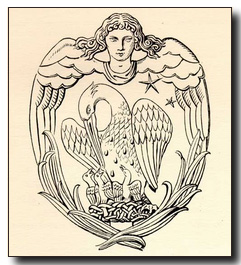 The elegant pelican animal totem is definitely an opportunist with style and finesse. In the wild, these large-billed birds perch themselves in the most advantageous position before swooping in to catch their prey. They wait patiently and focus intently, striking at the most perfect moment.

 Manuel Payno is a writer whose work brought as much joy as a flock of lorikeets. In the translator’s preface, Alan Fluckey describes the small riot that erupted when a ship, carrying copies of


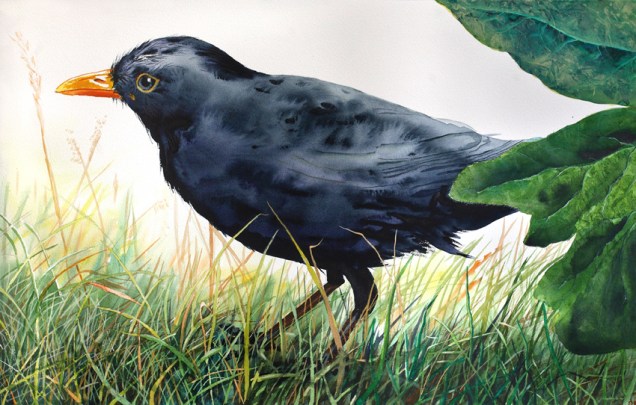 Blackbirds are known for their melodious voice where they sing from high places such as; rooftops, trees and any other elevated perch. They enjoy standing alone singing and catching the attention of others. Today blackbird is asking us to recognize our creative talent. While this may not be singing, there is a talent that each of us should unhesitatingly express. Rather than hiding our Light under a bushel we need to be singing from the rooftops!
 “The Arrernte word Awelye, from Central Australia, describes the interrelationship of everything; plant, animal, earth and language. Aboriginal knowledge about plants, animals, non-living things, spirit, economy, aesthetics, kin, responsibility and journeying bind types of information with one another.
 Of all the facts about the Superb Fairy-wren’s life that have been discovered over the years, none is more charming than one small detail of the male’s courtship behaviour. While wooing a potential mate, either in his territory or in somebody else’s, a male Superb Fairy-wren will pluck petals from a flower and present them to the female as a kind of bouquet.




 I am sure you remember the Choose Your Own Adventure books, where you’re chased by a tiger. You can escape it by leaping into the ocean 50 feet below (go to page 48) or face the tiger with your homemade slingshot (go to page 128).


 Even though MIDNITE was seventeen, he wasn’t very bright. So when his father died, his five animal friends decided to look after him. Khat, the Siamese, suggested he became a bushranger, and his horse, Red Ned, offered to help. But it wasn’t very easy, especially when Trooper O’Grady kept putting him in prison.


 An African proverb


 Once a jolly swagman camped by a Billabong


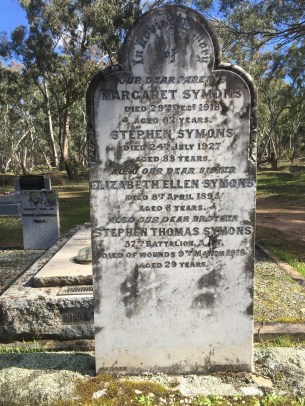 Margaret and Stephen Symons, of Moliagal, suffered the pain of losing their eight year old daughter in 1895. But it is likely that, the loss of their beloved son to the 1918 war, broke Margaret’s heart. She died in the same year.
 While Waiting For Godot