Mother, mother, what ill-bred aunt
Of what disfigured and unsightly
Cousin did you unwisely keep
Unasked to my christening, that she Sent these ladies in her stead
With heads like darning-eggs to nod
And nod and not at foot and head
And at the left side of my crib?
-Disquieting Muses 1957 Sylvia Plath

Back in the day, when I first began running writing classes, I used to invoke the Muse by setting up an altar, burning sage and having everyone actually imagine they could hear the rustling of gowns as the muses came to join us. Ask anyone who participated at that time and they will leave you in no doubt that the Muses were responsive. These wild women were overjoyed to be invited, having felt that they had been all but forgotten for centuries.
At this same time, I was establishing the Soul Food Cafe and one of the early sections I built was The House of the Muse. As a part of this feature, I gathered a collection of hymns to the muse. Then, when my late husband and I travelled throughout Europe for six months the absolute highlight was finally reaching Delphi, Mount Olympus and other sanctuaries in Greece. At Delphi, I called upon the Delphic Oracle and all but plunged myself in the famed waters of Castalia. I bought back bottles filled with water from the Castalian Spring, decanted the magical water into smaller bottles and gave these to those willing to anoint themselves and experience a heightened sense of creativity.
 Time has passed and I have never forgotten these big-hearted muses who were so responsive to my call for support. Perhaps it was these heavenly spirits who gently reminded me that there is a whole cast of female mystics who would willingly give their time to massage the creativity of those who feel that it has waned a bit.
Little wonder that, seemingly by chance, I came into possession of Mirabai Starr’s ‘Wild Mercy – Living the Fierce and Tender Wisdom of the Female Mystics’. It is the perfect text to introduce early in my Great Escape – Intensive Journal Writing Class.

To learn more about what we did in this class and to engage online you need to subscribe to Trains of Thought. To get the key to Trains of Thought choose the amount you are able to afford (no more than $40 in your currency), pay heatherblakey@fastmail dot fm via PayPal and contact her with details of your WordPress account. It is very easy to acquire an account with WordPress and you may choose to keep your intensive journal online in a private blog. Once you have subscribed, email me your WordPress account email and I will add you to the site. This is intended to become a collaborative blog and you will be able to post and comment.
 One of the deities most frequently seen on altars in China’s temples is Quan Yin (also spelled Kwan Yin, Kuanyin; in pinyin, Guanyin). In Sanskrit, her name is Padma-pâni, or “Born of the Lotus.” Quan Yin, alone among Buddhist gods, is loved rather than feared and is the model of Chinese beauty. Regarded by the Chinese as the goddess of mercy, she was originally male until the early part of the 12th century and has evolved since that time from her prototype, Avalokiteshvara, “the merciful lord of utter enlightenment,” an Indian bodhisattva who chose to remain on earth to bring relief to the suffering rather than enjoy for himself the ecstasies of Nirvana. One of the several stories surrounding Quan Yin is that she was a Buddhist who through great love and sacrifice during life, had earned the right to enter Nirvana after death. However, like Avlokiteshvara, while standing before the gates of Paradise she heard a cry of anguish from the earth below. Turning back to earth, she renounced her reward of bliss eternal but in its place found immortality in the hearts of the suffering.
  In a journal writing class, I remind you that within you beats a wild and compassionate heart, alive with fierce optimism. You have the courage to walk a path of transformation. You will not be tamed by convention. You are not afraid to be different, to take risks for what you love, and most of all, to keep hope in your heart. You are one of the wild ones.
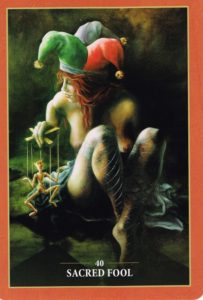 This is a time when we can unleash and play with the Sacred Fool. The fool is a great rebel, able to thwart conventions and tell the truth without restraint.
 It was Grand Final Day and crowds were packing the MCG. This is the day everything seems to stop in Melbourne and the city takes on the feeling of being a ghost town as people gather in venues to watch the match. It is the day of bar-b-ques and general partying.
 The area around Bealiba was originally known as Cochrane’s, after John and James Cochrane, who took up a pastoral run in 1853. When gold was discovered in 1855-56 the area was known as Cochrane’s Diggings, but the surveyor who laid out the township in 1862 adopted the name of the pastoral run, ‘Bealaba’, later Bealiba. It is thought that the name is derived from Aboriginal words meaning red gum creek.
 Once a hub for those seeking gold today Bealiba is a quiet little town. With nothing open to visit, I was content to go to the historic cemetery where one is inevitably confronted with the grief that people who lived in this harsh place endured. As the headstone I photographed testifies, the mortality rate amongst infants was very high. The loss endured by John and Mary Jones is hard to imagine.


 However, I do live in a house in George Street which has glass doors with images of Blue Gum Clippers of the kind they built in the Battery Point Ship Yards in Hobart.




 Emu is a powerful teacher and guide. It promotes spiritual excellence and achievement by encouraging diligence, hard work, respect and humility in the lives of those it visits. Emu demands the great application of time, energy and love to all spiritual pursuits and can guide those who seek knowledge down paths of wisdom.
 Children have loved contemplating how to build up their artistic eyes and they have written with speed and passion that is a joy to watch. Words literally fall on to the page within just ten minutes! Ballads, lyrics, complex drawings, news reports, fiction and folklore have emerged on their pages and the excitement, as they share their work and cheer one another on is palpable.


 The frilled lizard grows to around 45-90cm in length, about two-thirds of which is tail. It has a vivid yellow mouth and a large extendible frill gathered about the neck and under throat. The combination of the gaping mouth and the wide, brightly coloured frill provide an intimidating sight to any potential predator. It frequently runs at speed on two legs to escape danger, quickly climbing the nearest tree to safety. Their colour can be brown or grey with the frill being lighter and often tinged with orange or reddish-brown. Males are bigger than females and have a more robust appearance. There are two long, pointed canine-like teeth present in the lower jaw, which can inflict a painful bite.





 While Waiting For Godot