Building Upon Ancestral Foundations

Over 52 weeks I will be learning all about how to live and work creatively. My teachers are Aussie birds and animals. It is week four and the creative force has produced the Possum to build on the lessons that Australian birds, animals and habitat are initiating.

The tradition of using possum skins for the making of cloaks, waistbands, belts, armbands and headbands was practised by Aboriginal people across eastern Australia.

One of the earliest documented accounts of a possum skin cloak is from Governor Macquarie. In his journal on 10 May 1815 (Bathurst), he recounts that three Wiradjuri warriors, led by Windradyne, visited him and gifts were exchanged. Macquarie gave Windradyne a tomahawk and a piece of yellow cloth; in return, he received a possum skin cloak.

One example of cloak-making from this region is held in the Smithsonian Institute (Washington, DC, USA). Known as the Hunter River Cloak, it was collected during an expedition in the mid 1800s by American explorer Charles Wilkes. It features four rows of six rectangular pelts sewn on the back, edge to edge, with very fine overhand stitching of corded sinew. The fur has been left on and the skin side is completely covered with large diamond-shaped designs made by scraping up a thin layer of the skin so that it stands up in a little curl.3

Traditionally, cloaks were used for ceremonial purposes: in dance, drumming, initiation rites and also in daily life. They were primarily worn as a means of protection from winter conditions, but also used as a shelter from heat and wet weather and to carry babies and small children.

A local example of how valuable the cloaks were in trade is suggested by stories of the Darkinjung nation trading them with inland tribes in exchange for spears and woomeras. In the Dandenong region of Victoria, the trade value of a cloak was said to be worth a greenstone axe. They were also given as peace and marriage offerings.

Possum skin cloaks were created for individuals when they were born and were added to throughout their lives. The intricate designs and ochre decorations were either made by the individual or by others, depending on the design and the purpose for which they were being added.
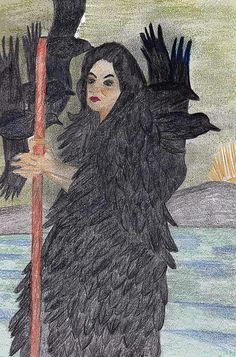
This practice reminded of a gift that I was given when I visited the  Isle of Ancestors. The Isle of Ancestors is a part of the Lemurian Archipelego, a fantasy world that I created during the hey days of the Soul Food Cafe. It is well worth a visit! Travellers have left rich stories of their meeting with their ancestors at this revered island.

At a point when I was feeling quite low I hitched a ride with the Ferrywoman and visited the sanctuary on the Isle of Ancestors. It was a moving experience as I met all my grandmothers. Before insisting that I return to the world I had come from, they gave me was a cloak filled with raven feathers to wear and provide comfort whenever I felt low.

This cloak held the life stories of the ancestors who walked before me and upon whose shoulders I now stand.

In her iconic book ‘Women Who Run With The Wolves’ Clarissa Pinkola Estes talks extensively about the importance of Soulskins. In her chapter, Homing: Returning to Oneself she talks about how women who have lost their pelt, lose their protections, their warmth, their early warning system and most devastatingly, their instinctual sight.

Possum urges us to see our life as being built upon the foundation of our ancestors; to wrap ourselves within a cloak and find anchorage with our ancestors.

There are many ways that we can honour our ancestors and to actively remember them.

Possum urges the creative to take the time to use some of the ways suggested in the linked articles or to make a metaphorical coat to record the journey. Actively taking tangible steps to honour our ancestors provides a foundation upon which great things can be initiated.

Personally, I found that I viewed my potential differently when I pulled the cloak I had been given out of the cupboard and celebrated wearing it on a daily basis.

The Advantages of Playing Dead

Over 52 weeks I will be learning all about how to live and work creatively. My teachers are Aussie birds and animals. It is week four and the creative force has produced the Possum to build on the lessons that Australian birds, animals and habitat are initiating.

This morning when I was out with the dogs, Archie alerted us to the fact that there was a possum tucked in the branches of one of the shade trees. It took us a moment to spy the frightened, frozen creature whose bright eyes seemed to be looking far far away. Given the fact that we were anticipating that temperatures would rise to 42c our primary concern was that this creature and its access to water. I have been filling vessels for the bird life at my house but with no tap in sight, there was little we could do.

Possum medicine uses a great deal of strategy. Possums are well-known for one of their tricks. These small animals are amongst a group of animals who have the capacity to play dead when predators are near. This way they trick other, larger animals, that they are dead and then attack them or avoid them after they give up on the hunt. This trick helps possums to survive in often dangerous habitats.

Despite idleness being dammed as slothfulness, as one of the seven deadly sins, inactivity plays a perfect role in human life! When we are idle we are actually keeping up a valuable tradition. There are many advantages to inaction! For a start, immobility conserves energy. A half an hour siesta can ward off coronary disease. Plato tells us that Socrates stood still for nearly 24 hours while ruminating on some particularly intractable problems.

Most people would recoil at the idea of doing this but they would be wise to learn from a possum. Sometimes we need to go into a torpor and not think about anything much. Sometimes we need to rest our brains and replenish, in readiness to receive messages from the creator and enjoy another creative spurt.


Rally Your Personal Spirits

Over 52 weeks I will be learning all about how to live and work creatively. My teachers are Aussie birds and animals. It is week three and the creative force has produced the Musk Lorikeet to build on the lessons that Australian birds, animals and habitat are initiating.

In Signs of Love from Heaven Above, Liz Winter explains that our angels and guides are with us all the time if we just care to look. In this article she describes how a lorikeet kissied her back to life and bought her into the present moment. She saw the lorikeet as a sign, a sign of love from Spirit. The Lorikeet seemed to be telling her to look at the beauty around her, look at where she was in that moment. She felt that the bird reminded her that she was not alone.

Loneliness is the elephant in the room for many creative people. Creating can feel lonely even when you are surrounded by others. Paradoxically, it is creating that is a salve to this sense of loneliness.

If you want to be an artist you  need to understand about the difference between aloneness and loneliness. Lorikeet reminds us that we do all have our personal Spirit Allies, ready and waiting to serve us. We only have to rally them for support. Their reward is the joy in our heart. We do not have to feel alone. We do not need to be shy about the Spirit World. We can talk to our guides, unload on them and ask for signs. They are there to help.

Even if it seems to be flitting from one place to another Lorikeet will listen today!

Go Coddiwompling

Over 52 weeks I will be learning all about how to live and work creatively. My teachers are Aussie birds and animals. It is week three and the creative force has produced the Musk Lorikeet to build on the lessons that Australian birds, animals and habitat are initiating.

Musk Lorikeets are endemic to (only found in) south-eastern Australia, being widespread in eastern New South Wales, all regions of Victoria and in the south-east of South Australia. They are found in tall, open, dry forest and woodlands, dominated by eucalypts and are usually found in the canopy. They are also seen in suburban areas, parks and street trees. They roost or loaf in tall trees away from their feeding sites.
Musk Lorikeets are considered nomadic, following the flowering or fruiting of food trees and they travel widely for food. One might say that the Musk Lorikeet likes to coddiwomple! To Coddiwomple is to travel with no fixed destination. Coddiwomple is just one of at least six words that habitual travellers need.

In 2001 my late husband and I travelled for six months throughout the United Kingdom, Western Europe and Scandinavia with no fixed destination and no forward bookings. Our theory was that if we did not have a destination or a specific address to find we could not get lost. It was an amazing journey and we never slept in the car we had hired. We always found a bed for the night. We didn’t realise it at the time but we were Coddiwompling! To Coddiwomple is To travel in a purposeful manner towards a vague destination. The Coddiwomple family are constantly travelling with no fixed destination. After he died and I sold the family home I had no real destination in mind. I let fate guide me to my current home in Central Victoria.

Believe it or not, you do not have to leave home to coddiwomple. Travellers who joined me in Lemuria had no fixed purpose and no fixed destination. They were virtual travellers who slipped through the portal and let the Enchantress decide where the next adventure lay!

They wandered about in Gypsy Caravans, stopping occasionally at mysterious places like the Well of Remembrance, the Lemurian Abbey, the Isle of Ancestors, Owl Island, the House of the Serpents and Riversleigh Manor. Jo Chapman is a virtual Coddiwompler! She has an imaginary boyfriend who she travels with and they have been to some exotic places.

These days my main coddiwompling is with my little Mazda 3, Akari! She and I love to go out on mystery tours! I let her randomly decide where we are going. Yesterday I went coddiwompling out into the natural habitat of some of the wildlife that also makes its way into my backyard.


Exploring the Expressive Arts

Over 52 weeks I will be learning all about how to live and work creatively. My teachers are Aussie birds and animals. It is week three and the creative force has produced the Musk Lorikeet to build on the lessons that Australian birds, animals and habitat are initiating.

Lorikeets are full of silliness and humour, and they are also inquisitive about their surroundings. These comical birds remind the writer and artist to be expressive and bring colour, humour and light into their work. Lorikeet has drawn me to examine Expressive Arts. Expressive Arts and Art Therapy are creative therapies. The concept of expressive art resonates for me because it honours the process, rather than the final product.

With the arrival of Lorikett I decided that this 52-week project is an expressive art project. I am unashamedly doing this for myself. Committing to 52 weeks is huge and it represents a major shift for me to be genuinely creating FOR MYSELF and FOR THE CREATIVE SPIRIT. I do not actually care if many people engage or follow what I am doing! I am interested in observing and researching the process of being responsive to and feeding the creative spirit.

The web is full of expressive art material. It is a huge field! I was particularly impressed to find the work of Shelley Klammer. On her site, she has an updated list of a popular internet list of art therapy activities which were originally posted by the Nursing School Blog

Lorikeet has suggested that I reprint the section on relaxation, along with a link to Klammer.

Relaxation

Art therapy can be a great way to relax. Consider these exercises if you’re looking to feel a little more laid back.

  1. Paint to music. Letting your creativity flow in response to music is a great way to let out feelings and just relax.
  2. Make a scribble drawing. With this activity, you’ll turn a simple scribble into something beautiful, using line, color and your creativity.
  3. Finger paint. Finger painting isn’t just fun for kids– adults can enjoy it as well. Get your hands messy and really have fun spreading paint around.
  4. Make a mandala. Whether you use the traditional sand or draw one on your own, this meditative symbol can easily help you to loosen up.
  5. Draw with your eyes closed. Not being able to see what you are drawing intensifies fluidity, intuition, touch and sensitivity.
  6. Draw something HUGE. Getting your body involved and moving around can help release emotion as you’re drawing.
  7. Use color blocks. Colors often come with a lot of emotions attached. Choose several paint chips to work with and collage, paint and glue until you’ve created a colorful masterpiece.
  8. Let yourself be free. Don’t allow yourself to judge your work. If you think your paintings are too tight and controlled, this collection of tips and techniques to try should help you work in a looser style.
  9. Only use colors that calm you. Create a drawing or a painting using only colors that you find calming.
  10. Draw in sand. Like a Zen garden, this activity will have you drawing shapes and scenes in the sand, which can be immensely relaxing and a great way to clear your mind.
  11. Make a zentangle. These fun little drawings are a great tool for letting go and helping reduce stress.
  12. Color in a design. Sometimes, the simple act of coloring can be a great way to relax. Find a coloring book or use this mandala for coloring.
  13. Draw outside. Working en plein air can be a fun way to relax and get in touch with nature while you’re working on art.

Perhaps I will get back to drawing a donkey and a raven a day!

Create Colourful Portraitures

Over 52 weeks I will be learning all about how to live and work creatively. My teachers are Aussie birds and animals. It is week three and the creative force has produced the Musk Lorikeet to build on the lessons that Australian birds, animals and habitat are initiating.

They talk with their beaks full of blossom
In a cascade of chatter as they sidle
Invisibly through the swaying treetops
They fly in a hurry as if all the gumnuts
Would disappear before they got to them
Geoffrey Dutton

Musk Lorikeets have been feeding on the fruit in my yard, hurling stone fruit onto the roof of the galvanised shed that the fruit tree spreads its branches over. The ground is covered with kernels, hastily discarded as the birds flit off looking for the next treat! These joyful creatures bring brightly coloured plumage and comic antics into my world.

The Rainbow Lorikeet and Musk Lorikeet have inspired rich poetic characterisations, with poets depicting them as gangs of unruly, chattering, aerodynamic, comical bandits. Geoffrey Dutton and Mark O’Connor are just two Australian poets who personify the spirit of these free-ranging, social creatures.

Lorikeets are full of silliness and humour, and they are also inquisitive about their surroundings. They remind the writer and artist to bring colour, humour and light into their work.

Manuel Payno is a writer whose work brought as much joy as a flock of lorikeets. In the translator’s preface, Alan Fluckey describes the small riot that erupted when a ship, carrying copies of  The Bandits from Rio Frio in its cargo, arrived in Mexico. Boxes were hastily opened and copies were sold within minutes as people greedily hustled to get their own personal copy. Book in hand Mexicans sat about in the open air reading to their neighbours! Rainbow chatter filled the air!

Lorikeet and Payno come whirling into my world, reminding me to remind everyone to be exuberant and add colour to their writing; to write and paint about colourful places and colourful characters! Examine the work of Payno closely! Combine this with a copy of The Donkey Inside by Ludwig Bemelmans! Your work will be enriched!

Rainbow Lorikeets
by Mark O’Connor

To feed head-down in an aerial smother of honey and pollen
reassured by a rainbow chatter of siblings
changing tree on impulse
in case python or man is stalking,
reckless till then . . .

A frantic pillaging crew,
crimson-patched pirates screeching in plunder-frenzy,
ignoring the silver-eyes nervously feeding
under those orange scimitars of beak.

The first dozen leave in a second, headlong, a rapid
scatter of downward notes; greedy last tilts his head
and is traumatised by a blank grey-green
widowed of reds and orange.

Before long they’ll circle back.

Shrieks of “Saps up”, “Feed here!”,
churrs of “All’s well, Honey flows”,
screech of “Hawk’s shadow! Watch out!”
mute to the mating thrum
Bill-and-Coo, Tickle-and-Tweek.

Their world is millions of honey-dripping pores.
Free as a child with a million breasts to suckle,
the world’s glands, daytime and night,
at work making sweets for them.

“Comic book bandidos”, but equally
rainbow-motley clowns; with their walk-claws
they tread-cling, wading and stumbling
up loose sprays of blossom
as a lily-trotter walks floating weeds.
They clutch-bunch and jostle on rafts of leaf
buoyed there by bough-spring, then flare out
over forests where the tenth tree in rotation
is an oasis of dripping pompoms.
Their brush-tongues delving and combing
bully honey from bottle-brush florets
or bite them off short,
munching sweet mash.

This desert of unfruiting trees,
deluding the settlers with woody semblances,
is their land of nectar and pollen-bread, antipodean
paradise, where raucous workers thrive.
A good tree gives gallons a day
— but modestly, from flowers as dull as grasses,
pale cream or off-white, blanched foliage.
Birds themselves must play petal;
their stridulous yellows and blues and orange and red
flag out each tree of delights, proclaim the loud shrines
of fermenting, honeyed, winey abundance.

It is said the birds came from dinosaurs.
Rainbow dinosaurs.

Some Colourful Characters Who Populated Lemuria
Heather Blakey 2004 – 10

Freeing the Caged Bird

Caged Bird By Maya Angelou was first published in her book, “Shaker, Why Don’t You Sing?” in 1983. The poem is a Metaphor illustrating the differences between African-Americans and Whites during the civil rights era. The author, a black who grew up in the South during this era, is expressing her feelings at the discrimination she faced during her life. Her first autobiography published in 1970 is titled, “I Know Why the Caged Bird Sings”

Flying Free by Heather Blakey 2004

Angelou’s poem, Caged Bird, speaks to many who have known what it is to be caged, to have their wings clipped and struggle to leave the cage even when the door is opened. Over the years I have found that many creative people have had their wings clipped by the inner critic.

The inner critic or “critical inner voice” is a concept used in popular psychology and psychotherapy to refer to a subpersonality that judges and demeans a person. The inner critic is usually experienced as an inner voice attacking a person, saying that he or she is bad, wrong, inadequate, worthless, guilty, and so on. It feeds on the words of some teachers, parents and other societal influences.

When I slipped through the portal into the imaginary world of Lemuria I found a world where I could become a bird and float on the back of the Lemurian breezes, dip my golden wings and claim the sky as mine. It was a glorious sense of freedom! More recently I have collected old bird cages and leave them, with doors wide open, scattered throughout the garden.

The free bird leaps
on the back of the wind
and floats downstream
till the current ends
and dips his wings
in the orange sun rays
and dares to claim the sky.

But a bird that stalks
down his narrow cage
can seldom see through
his bars of rage
his wings are clipped and
his feet are tied
so he opens his throat to sing.

The caged bird sings
with fearful trill
of the things unknown
but longed for still
and his tune is heard
on the distant hill for the caged bird
sings of freedom

The free bird thinks of another breeze
and the trade winds soft through the sighing trees
and the fat worms waiting on a dawn-bright lawn
and he names the sky his own.

But a caged bird stands on the grave of dreams
his shadow shouts on a nightmare scream
his wings are clipped and his feet are tied
so he opens his throat to sing

The caged bird sings
with a fearful trill
of things unknown
but longed for still
and his tune is heard
on the distant hill
for the caged bird
sings of freedom.

Source: https://www.familyfriendpoems.com/poem/i-know-why-the-caged-bird-sings-by-maya-angelou

A Foraging We Go

Over 52 weeks I will be learning all about how to live and work creatively. My teachers are Aussie birds and animals. It is week two and the creative force has produced the Common Blackbird to build on the lessons that the Superb Blue Wren initiated.  

The dictionary describes foraging as a “search for food or provisions.”

Essentially, foraging is the purest and simplest of instincts. The natural reaction to hunger is to seek out food, and before the 24-hour convenience of neatly-arranged supermarket aisles, we scoured the countryside for something, anything, that would sustain us.

Not so many years ago, if you left the house with a wicker basket to harvest food, most people would snigger and point you towards the nearest supermarket. Mushrooming? Heaven forbids; the fungi world was fraught with danger. However, enter celebrity chefs like Jamie Oliver! They have enlightened us about the edible delights that can be found on our doorsteps. Now, any chef worth his or her Michelin salt is foraging or sourcing wild food that sings with natural, integral flavours.

♠ Watch the common blackbird foraging! What are twenty things you observe about the art of foraging?

You might head out with a basket and forage for food or, like me, you might adapt the definition of foraging. For my purposes foraging is the search for food or provisions which will feed my creative spirit! I let my fingers do the walking and under the tutorage of the sharp-eyed blackbird, seek out creative stimuli that will further my creative endeavours. Alternatively, I go to charity stores, second-hand collectable places, libraries, bookshops etc and just see what turns up.

After stumbling upon the Curious Origins of Sing a Song of Sixpence  I was intrigued by where examining a simple nursery rhyme might take me. As the writer of this article says, delving into peoples attempts to find meaning in what was probably a jaunty ditty to amuse children, has been a voyage of learning  in so many ways. How else would we learn about the notorious life of Edward Teach, the medieval splendours of entremet, the lacklustre poet laureate Henry Pye and the larger than life shenanigans of Henry the VIII.

Random Acts of Foraging

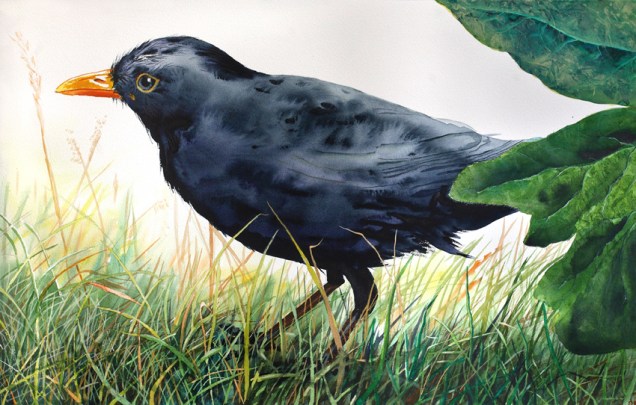
The Irish Blackbird, Turdus merula, is a common, resident bird; the males are solid black with a bright orange beak, and the females tend to be brownish in colour (Irish Birds). They are well-known for their abilities as beautiful songsters, and it is because of this trait that they appear often in the literature. ”The ‘Three Birds of Rhiannon’ [a Celtic goddess and queen] were said to have the ability to sing the dead to life, and the living into a sleep of death”, and these birds were also the “harbingers of the Otherworld, and their singing at Harlech in the tale of Branwen suspends earthly time”.  Considering their talents with a song, it comes as no surprise that the Blackbird is generally seen in the role.  In addition, the blackbird’s importance is consistently seen in the native set of symbols as being one of the “Oldest Animals”, in other words, an animal that has been around since the beginning of time, and has learned much about how the world works. Source

Blackbird Fact Sheet

The Story of the White Blackbird  The White Blackbird” is a charming satire on the literary life of Alfred de Musset’s time, exposing not merely the ease with which popular taste is imposed upon and some current types of literary humbugs, but also the universal tendency to confound mere eccentricity with genius.

Three Little Birds” is a song by Bob Marley and the Wailers. It is the fourth track on side two of their 1977 album Exodus and was released as a single in 1980. The song reached the Top 20 in the UK, peaking at number 17. It is one of Bob Marley’s most popular songs.

This happy, upbeat tune tells the tale of three birds who helped remind Bob Marley that “every little thing is gonna be all right.”  Marley died on 11 May 1981 at Cedars of Lebanon Hospital in Miami (now University of Miami Hospital), aged 36. The spread of melanoma to his lungs and brain caused his death. His final words to his son Ziggy were “Money can’t buy life.” In his lifetime he certainly spread his wings and flew! He leaves a rich legacy

♠ What does Blackbird help you find! Where does the treasure take you? Feel free to gloat and tell us about any treasure that you find under a leaf!

Sing from an Elevated Perch

Over 52 weeks I will be learning all about how to live and work creatively. My teachers are Aussie birds and animals. It is week two and the creative force has produced the Common Blackbird to build on the lessons that the Superb Blue Wren initiated.  

Blackbirds are known for their melodious voice where they sing from high places such as; rooftops, trees and any other elevated perch. They enjoy standing alone singing and catching the attention of others. Today blackbird is asking us to recognize our creative talent. While this may not be singing, there is a talent that each of us should unhesitatingly express. Rather than hiding our Light under a bushel we need to be singing from the rooftops!

Blackbird inspired The Beatles who wrote a song about him:

Blackbird singing in the dead of night
Take these broken wings and learn to fly
All your life

You were only waiting for this moment to arise
Blackbird singing in the dead of night
Take these sunken eyes and learn to see
All your life
You were only waiting for this moment to be free

Blackbird fly Blackbird fly
Into the light of the dark black night

Blackbird fly Blackbird fly
Into the light of the dark black night

Blackbird singing in the dead of night
Take these broken wings and learn to fly
All your life

You were only waiting for this moment to arise

Today Blackbird is reminding us of the need to celebrate our creative talent, build a firm foundation upon which to create and pay close attention to the details. Blackbird is reminding us to listen to the wisdom of Paul McCartney and Maya Angelou’s And Still I Rise.

Blackbird is encouraging us to repair our broken wings, take the moment to arise and share our inspirational gifts with the world.

A participant in one of my writing courses told me that, I had to keep sharing my gift, that I would be selfish to keep the gift hidden under a bushel! Blackbird has encouraged me to arise, puff out my chest and sing, without inhibition, from an elevated space! I am a gifted purveyor of creative stimuli who has shared inspirational ways to promote creative endeavour. I do this by working on projects like this and by putting together an apothecary (a new form of the Soul Food Cafe) for those who wish to feed the creative spirit.

What will you share with the world?

Courting the Creative Spirit

Over 52 weeks I will be learning all about how to live and work creatively. My teachers are Aussie birds and animals. It is week one and the creative force has produced the Superb Blue Wren to provide some lessons!

Of all the facts about the Superb Fairy-wren’s life that have been discovered over the years, none is more charming than one small detail of the male’s courtship behaviour. While wooing a potential mate, either in his territory or in somebody else’s, a male Superb Fairy-wren will pluck petals from a flower and present them to the female as a kind of bouquet.

Males are also known for the ‘seahorse flight’, named for its seahorse-like undulations, during which the male—with his neck extended and his head feathers erect—tilts his body from horizontal to vertical, and descends slowly and springs upwards by rapidly beating his wings after alighting on the ground. The ‘face fan’ display is also noted as a part of sexual display behaviours; it involves the flaring of the blue ear tufts by erecting the feathers.

Whether this increases his chances of mating or not is hard to know; but it’s hard not to smile at the thought of this tiny, colourful bird carrying such an offering.

Artists who court the muse want to tap into that mysterious source of artistic inspiration all creative people seek. They search for a more knowing, more spiritual inner wisdom – something inside or even outside themselves that will inspire and inform their art. That inspirational, essential wisdom points the way inward, toward the emotions, the psyche, the soul. It calls upon us to cultivate a healthy relationship with the deep well of creative mystery that lies within.

What ritualistic displays might you devise to court and nurture the creative spirit? How will you use the reflective faculty we have within?

“Discipline is very important. I think we’re creative all day long. We have to have an appointment to have that work out on the page. Because the creative part of us gets tired of waiting, or just gets tired.” — Mary Oliver

“If Romeo and Juliet had made their appointments to meet, in the moonlight-swept orchard, in all the peril and sweetness of conspiracy, and then more often than not failed to meet — one or the other lagging, or afraid, or busy elsewhere — there would have been no romance, no passion, none of the drama for which we remember and celebrate them. Writing a poem is not so different—it is a kind of possible love affair between something like the heart (that courageous but also shy factory of emotion) and the learned skills of the conscious mind. They make appointments with each other, and keep them, and something begins to happen. Or, they make appointments with each other but are casual and often fail to keep them: count on it, nothing happens.

The part of the psyche that works in concert with consciousness and supplies a necessary part of the poem — the heart of the star as opposed to the shape of a star, let us say — exists in a mysterious, unmapped zone: not unconscious, not subconscious, but cautious. It learns quickly what sort of courtship it is going to be. Say you promise to be at your desk in the evenings, from seven to nine. It waits, it watches. If you are reliably there, it begins to show itself — soon it begins to arrive when you do. But if you are only there sometimes and are frequently late or inattentive, it will appear fleetingly, or it will not appear at all.” Mary Oliver

♥ Make an appointment with the creative spirit today! It is enough to just hang out together!

♥ Visit Contemporary Aboriginal Artist, Mirree and learn about how Wren Dreaming can help nurture your creative spirit. Perhaps you will treat the creative spirit to some of Mirree’s beautiful Oracle Cards and her Dreamtime Colouring Book. I use a deck like this to determine who will be the next animal to enter my space and insist that their voice be heard.

Singing Over Our Creative Eggs

Over 52 weeks I will be learning all about how to live and work creatively. My teachers are Aussie birds and animals. It is week one and the creative force has produced the Superb Blue Wren to provide some lessons!

Mothers usually set about teaching their offspring the moment they’re born. But the females of this  Australian bird can’t wait that long. Researchers discovered, by accident, while recording at fairy-wren domed nests, that female fairy-wren were singing to their eggs.

The females of superb fairy-wren (Malurus cyaneus) start singing to their unhatched eggs in order to teach the embryo a “password,” a single unique note, which nestlings must later incorporate into their begging calls in order to get fed. This trick allows fairy-wren parents to distinguish between their own offspring and those of cuckoo species that invade their nests. The females also teach the pass-note to their mates. This has the potential of opening up new lines of inquiry into prenatal learning systems.

In her book, Women Who Run With the Wolves, Clarissa Pinkola Estes talks about singing over the bones to feed the creative spirit. As an artistic midwife I am familiar with the creative birthing process, but until the blue wren flitted into my world I had not thought of encouraging creatives to “sing over their eggs’