Headstone Story Boards

A storyboard helps you:
Define the parameters of a story within available resources and time
Organize and focus a story
Figure out what medium to use for each part of the story

Akari, my adventuring little Mazda 3, seemed determined to increase my knowledge of this region, a region I was drawn to when my life changed so completely after multiple losses. During a semester break over winter, I learned about exploring cemeteries. I discovered rich history lying quietly in historic old cemeteries. As my collection of regional headstones grew, so did the picture of just how much the Gold Rush impacted on the lives of those who came here. It was certainly not an easy life. The Pennyweight Cemetery where over 200 children lie buried, is perhaps, the most poignant. However there was one headstone that inspired me to use Pablo Neruda’s line, Tonight I write the saddest lines!

The more I travelled, the more I found windows to the past. The grave of Elizabeth Escott and her daughter Fanny lies in bushland on the east side of the road to Fryerstown. When Elizabeth’s husband died, she left England with her eleven children to make a new life in Australia. She was one of many who were beaten by the hardships of life on the diggings. Fanny was sixteen when she died of consumption at Blacksmith’s Gully in 1856, and Elizabeth died six months later. Another daughter, Mary, had died in 1855.
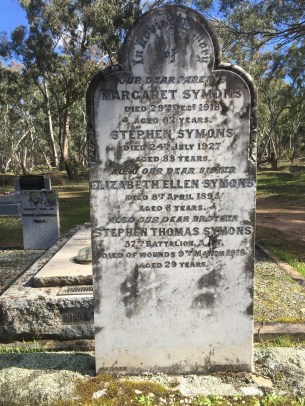
Margaret and Stephen Symons, of Moliagal, suffered the pain of losing their eight year old daughter in 1895. But it is likely that, the loss of their beloved son to the 1918 war, broke Margaret’s heart. She died in the same year.

There are many activities that can stem from a visit to a cemetery

On a recent trip to Penang, my daughter and I found the Historic Protestant Cemetery captivating. I am happy to simply create a post about this hauntingly beautiful cemetery. However, going to this cemetery could kick start a whole lot of other creative activities, including further research into Penang’s amazing history.

ACMI has a story board generator for those who want to build a background for their films. Aside from the use of storyboarding, as envisaged by Walt Disney, storyboards will enable you to see an entire novel at a glance.

Akari’s Mystery Tour

Definition: a mystery tour is a short journey that people make for pleasure without knowing where they are going

Akari, my 2008 Mazda 3, specialises in magical mystery tours that feed the soul and the creative spirit. Akari knows all about duende, that raw, tempestuous creative energy that flamenco guitarists, gypsies and dancers are familiar with. Her inclusive tours take in all aspects of Central Victoria including: geology, the environment, culture, flora, fauna and history.

A mystery tour is all about anticipation! Those who come on one of Akari’s tours, especially visitors from other countries, are always surprised when Akari takes them to some out of the way  place that reveals a different perspective of Australia. They are always  inspired !

Today, with the smell of spring in the air, my dogs and I went out on an artistic date with Akari.


In Art Heals: How Creativity Heals The Soul, Shane McNiff says that ‘photography can help us become more aware of our environments. When we walk with a camera searching for images… this process helps us look more closely and deeply at our surroundings.” There is no doubt that the camera has the capacity to hold moments of our perception and help us to see the possibilities for perceptual awareness.

I took the time to receive the benefits of aesthetic contemplation and to look attentively.  My perceptions were not all captured by the iPhone! Moliagul is almost a ghost town now yet it proudly boasts being the site where the Welcome Stranger Gold Nugget, found here by John Deason, changed Australian History.  Moliagul also has an amazing monument to John Flynn who pioneered the Australian Inland Mission Aerial Medical Service in Cloncurry, Queensland (later to be renamed the Royal Flying Doctor Service). At one time he was the headmaster at the small iconic school I stopped to photograph.

This meditation brings a new energy and creativity into my life. The fruits of Waiting For Godot over the past three months are beginning to ripen. There are so many things I can do with the images I collected on this ‘tour’ with Akari! I look forward to a rich harvest.

Mcniff, S 2004, Art Heals: How Creativity Cures The Soul, Shambala, Boston

Harsh Times on the Goldfields

Life in the 1850’s in Hobart Town was not easy. Like my great grandfather it is  likely that this family were drawn to the Victorian goldfields, from Hobart, lured by the prospect of finding gold and making a fortune.

Disease was rife upon the goldfields, where poor sanitation meant that refuse and excrement were liable to end up in the rivers that supplied drinking water for those on the diggings. Dysentery, typhus and other contagious diseases were all represented. The monotonous diet of mutton and damper did not help the health of diggers, and it is probable that many people, especially during the first years of a rush, were deficient in essential nutrients and vitamins. Common colds could be lethal; because of the combination of lack of sanitation and poor diet, miners lacked the necessary antibodies to fight off disease. With a weak immune system, a cold could quickly develop into pneumonia.

Within a week something of plague proportions wiped out Elizabeth Smart and her children. It is hard to imagine how Elizabeth Smart’s husband managed the grief of the loss of  his wife and children within such a short time . The experience of life on the goldfields was different for all who arrived, but few, as this tombstone reveals, had it easy. This husband and father had it tough.

Sacred To The Memory Of
Elizabeth Smart
Native of Hobart Town
Who Died July 5th 1864
Aged 26 Years
Also
Salena Smart
Who Died July 5th 1864
Aged 5 Years
Also
Henry Smart
Who Died July 8th 1864
Aged 5 Years
Also
Elizabeth Smart
Who Died July 10th 1864
Aged 14 Days

Weep not for me my husband dear 
I am not dead but sleeping here
Weep not for me but pity take
And love my children for my sake

Chinese Cemetery Vaughan Springs

In 1861, there were more than 24,000 Chinese immigrants on the Victorian goldfields of Ararat, Ballarat, Beechworth, Bendigo, Castlemaine and Maryborough. 

Vaughan Springs was once a large gold rush town called “the Junction”. Many Chinese miners moved there in 1854 and searched for alluvial gold in areas that had been abandoned by the Europeans. They established market gardens and Vaughan became an important stopover.

The Chinese diggers moved from goldfield to goldfield within NSW and across the border. Constantly on the move, their presence and experience are evidenced mainly from the observations and interpretation of Anglo-Australians, from archaeological digs and from objects saved by families and community members. There are few written accounts and sources from a Chinese perspective. The Chinese attracted particular attention and local newspapers were quick to comment on their distinctive features, clothes, languages and habits — especially their tendency to travel en masse — their methods of transport, their diligence, tirelessness and productivity.

Any admiration of their work ethic was offset by envy and resentment when times got hard. The Chinese were often scapegoated by disgruntled Anglo diggers as seen in the violent anti-Chinese riots at Turon (1853), Meroo (1854) Rocky River (1856) Tambaroora (1858) Lambing Flat, Kiandra and Nundle (1860 and 1861) and Tingha tin fields (1870). They were seen initially as oddities, later as rivals and then as threats to white Australia.

Today the small Chinese Cemetery on a rise above the mineral springs is very different to the waste land created by the gold rush. Now it is a quiet, tranquil place for those who were not taken home to China, but who now rest here. Likewise, Castlemaine Cemetery has a very beautiful grove for the Chinese who died on the goldfields.


Make a Mailbox Happy and Improve your Mood

Painting, sculpting, dancing, making music, and all the other artistic pursuits have benefits that go far beyond pure enjoyment or cultural creation — these activities can also strengthen your brain and improve your mood.

Since the inception of emailing and texts mail boxes around the globe have lain empty, gathering bills and cobwebs, lamenting the lost art of letter writing, waiting for Godot to come, deposit something and make them loved again.

The therapeutic benefits of unsent mail are quite well known. They are a powerful journalling tool! When running courses I promoted letter writing as a way of firming ideas for a novel or script. I also had participants write formal letters to themselves and posted them weeks after they were written. When my 35-year-old son moved to Berlin and was taking time to settle to his new life I took to writing to him and including silly drawings and fun stickers. He enjoyed the looks on the faces of people in cafes when he said that he was writing a letter to his mother.

A Brisbane postman makes fake letters for a dog. Pippa the dog always runs towards Martin Studer, a postman from Brisbane, whenever she sees him – she loves getting mail! In fact, the pooch enjoys it so much, the postman even writes tiny letters especially for her. He does not want to upset the good girl. “Sometimes, Pippa comes out for the daily delivery but there’s no mail for her to collect,” Studer writes on Facebook. “So I have to improvise.”

“I’ve been on Pippa’s run for the last 2-3 years,” Studer told Bored Panda. “I have always written something to her.  She LOVES the postie. It really makes her day when we come by.”

I totally understand how Pippa feels. I have vivid memories of the letters, resplendent with foreign stamps arriving. I had friends in America and Canada and still have a small skunk brooch that my Canadian pen pal sent me. Much later, when I was running Soul Food, some participants sent parcels and they were greeted with delight.

There are sites, like Snail Mail Pen Pals, that will connect people to pen friends but there are plenty of innovative ways to find a pen pal and engage in snail mail exchanges such as these. A recent article talked about reasons to do art even if you are bad at it. My daughter and I love sending ridiculous postcards from our own airport before boarding to go overseas. We usually add embellishments to the name of the recipient, some of which are best not mentioned here. Mail Art is a fun place for a budding artist to start.

In a post on Miss Pelican’s Perch, Lori Gloyd remembers the work of Nick Bantock and the Extraordinary Correspondence of Griffin and Sabine. She brainstorms and considers 

“I got to thinking maybe I could tell an epistolary short story on my break. It will be a challenge since I don’t have access to Photoshop, my favored tool of visual creations. I may have to go old school with pen and paint. And then there’s the question: from whom shall the correspondence come, to whom shall they go, and what story shall it tell?”

Here is a list of more Epistolary books.

Suffer the Children

Life on the goldfields was particularly harsh on children. They were often used as a source of labour and could earn small amounts of money for errands. Their young immune systems were still developing and children were highly susceptible to diseases that sometimes ran through mining communities. However, even the young were drawn to the lure of gold and could also be found panning along the rivers.

Aside with the associated danger of children wandering off and getting lost, the poor and inadequate drainage of the early settlements caused much discomfort not only for everyone’s olfactory nerves but on the community’s health problems.

We take for granted the way in which we can now store perishable foods, having a clean water supply, a well operating sewerage system and the many other conveniences at the press of a button or flick of a switch.

When we really think about it, how would we cope under the circumstances that the early diggers and their families faced when they first arrived here? There were a number of diseases which were fatal to the goldfield’s population, and the health officer of the local council in co-operation with the police had to be extremely vigilant. Police and health officials were a partnership which we rarely consider at the present, but at the time  this was almost a symbiotic relationship.

An example of this is that it was an appointed police officer who made inspections regarding sanitation or the lack thereof, and made demands that certain activities had to cease or be curbed, such as slaughtering and butchering animals in one’s own back yard. Another instance which was recognised as undesirable was to allow cesspools to sit and stagnate on private land.

If the drains which had been commissioned and dug by the council on the sides of roads had insufficient fall, these too were a problem as animal waste accumulated in these low spots, along with road runoff from the horses and bullocks used in transport. Effluvia was a frequently used word to describe the gaseous smells emanating from the decaying organic material lying in the street gutters. Another word, now not in regular use, to describe the horrific gaseous smells was miasma.

Many people thought that the smell alone would be the transmitter of disease, however it was not generally understood that water and milk were, in the 1850s, the cause of many of the health afflictions which beset the community. Diphtheria is a disease which is rare today, yet it was very troublesome in early Bendigo. Diphtheria is highly contagious, its symptoms are a very high fever and difficulty in breathing and swallowing as it produces a false membrane in the throat.

In the mid 1870s diphtheria created great alarm as it had caused the deaths of a significant number of infants, with older members of the community not being spared either. Those who were treated in hospital for diphtheria were few and far between, as frequently by the time the disease was diagnosed it was already too late. Source: Bendigo Weekly.

In these conditions it was the children who suffered and the Pennyweight Cemetery is a testimony to the number of children who perished on the Forest Creek Diggings.

A Child’s Life on the Goldfields

What life was like on the Goldfields

Life for Children on the Goldfields

Become Rock Nerds

Majestic mountains, breathtaking canyon views, gorgeous arrays of sea stacks and beautiful sandstone arches are but a few of Mother Nature’s wonders that beckon photographers worldwide. These geological features lure artists of all kinds to paint, preserve, photograph, or sculpt. They’ve been cut by rivers, uplifted by faults or folds, carved by the wind, and eroded by time.
Russ Burden

When I was out taking some photos of this anticlinal fold in the Kalimna Park, just behind Castlemaine, I was asked if I was a rock nerd. I laughed! That is a term I associate with someone like Tim Minchin, but I confess I have been looking at rocks quite a bit lately.

A new global craze has kids all over the world getting outdoors to play hide and seek with hand-painted rocks. Kids are naturally interested in rocks. How many times have we witnessed students climbing on large boulders, collecting rocks, or throwing pebbles in the river?

The painted rock craze has been praised as a cheap and easy way to get kids away from technology and outside.

The hidden rocks are typically small, flat garden stones with a simple picture or a nice message painted on either side.

The rocks are hidden in parks, with photos posted on a Facebook page so other parents can take their children to find the rocks, then re-hide them somewhere else.

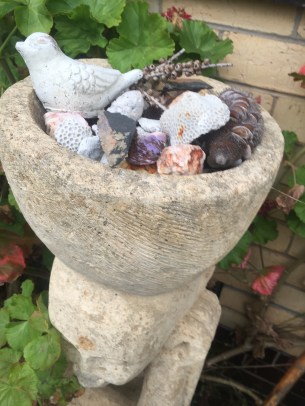
Rather than paint them I am happy to keep a small collection in the garden this lovely statue.

Educating students on rocks and minerals is an important and fun part of  science curriculum. This activity will lead to many more fun things to do and may result in an interest in photography and  a growth of interest in geology.


Two Feuding Volcanoes

The land around here is ancient. About 480 million years ago it was all under the sea. Then a couple of tectonic plates collided deep underground, squeezing everything like a vice.

I love the idea of sitting on the top of Tarrengower reading the story, as told by Justice B Nelson, and published by Culture Victoria, of two feuding volcanoes named Tarrengower and Lalgambook (Mount Franklin)

“A long, long time ago, long before anyone but the Traditional People walked our Country, our lands, rivers, mountains and animals alike, all had magical life. They had personalities, purpose, speech and they could think for themselves.

Tarrengower in the Dja Dja Wurrung means to be big and heavy and indeed he was just that; big, bold, wise and a very proud old volcano who had become very tired throwing out rocks and lava and preferred to sit humbly watching over the plains.

Another volcano called Lalgambook was a young, loud and cheeky volcano that started to challenge old Tarrengower’s wisdom and authority, and began grumbling and building up anger towards the old volcano. But Tarrengower, being the wise old volcano that he was, decided he should just try to ignore this cheeky little volcano.

Lalgambook grew even angrier that Tarrengower wasn’t acknowledging his threats and started to put on a display of smoke, ash and brimstone to impress the land and animals who were also watching, but this didn’t intimidate the wise old Tarrengower. Instead he just laughed at Lalgambook.

Lalgambook became so frustrated that he began to throw large rocks at Tarrengower who grumbled with annoyance at this cheeky volcano and Tarrengower now began to taunt young Lalgambook by telling him he wasn’t very strong at all because the rocks couldn’t reach him.

Lalgambook exploded with great fury, spurting out lava and smoke high into the sky and hurled gart gart in Tarrengower’s direction, but still could not reach him. This caused Lalgambook to completely blow his core!

Tarrengower’s anger eased and he just grumbled at this cheeky little volcano who was now just coughing and spluttering with no energy left at all.

All the rocks thrown by Lalgambook at Tarrengower can still be seen today and have formed what is known in the present day as the Guilford Plateau where the Jaara people would perform ceremonies on the Bora grounds also known as Yapene.”

Re-told by Justice B Nelson – Dja Dja Wurrung, Jaara
Content in Culture Victoria is free for educational use.

Copyright of this story
The writers, photographers and the State of Victoria

In Game of Thrones men have maintained a watch on the wall for thousands of years. The fire tower on top of Mount Tarrengower has been consistently manned by firespotters, long term occupants of the tower, since the days of Oliver Ralph in the 1950’s. Most recently Peter Skilbeck has been on the watch!

The Advance Maldon Association brought the tower that stand on the top of Mount Tarrengower from Bendigo to Maldon to attract visitors to the area after the goldmining had almost ceased. The tower was originally the poppet legs of the Comet Mine in Bendigo, and was brought to Maldon by rail in 80′ (24m) lengths. It was carried up the mountain on a timber jinker drawn by a team of horses, along a track cut from Butts Reserve to the summit. A Mr. William Adams put up the money for the project, approx. 600 pounds. During the Maldon Easter Fair, held annually since 1877, the lookout tower is illuminated. Prior to the 1950s, this was done by wiring up over 100 makeshift lanterns, using stone ginger beer bottles, hemp wicks and kerosene. The bottles were hidden in a disused mine shaft until the next Easter.
Source: Fire Lookouts Downunder

The viewing distance from this tower is up to 100 km in all directions, except northwards to Bendigo and Mount Alexander where it is about 30 km.

Take the time to visit Mount Tarrengower and the cheeky younger volcano across the way. Learn about the spirits of volcano’s and draw upon their energy.

Volcano Folklore:

Land of Volcanoes

Merapi Volcano Spirit Keeper

Volcano Eruption Myth

Volcano Folklore

This page is only meant for educational use!

The Stones and Ground Here Tells Stories

Recently I have taken to exploring cemeteries.  A taphophile, otherwise known as Tombstone tourist, cemetery enthusiast, detective or graver is an individual who has a passion for and enjoyment of cemeteries, epitaphs, gravestone rubbing, photography, art, and history of (famous) deaths.

I am not sure I will become a taphophile but I can see how visiting cemeteries can become quite addictive. Cemeteries tell the histories of our towns, states, and our country as well as the stories of all the people who lived in the community. Apart from being able to contemplate the meaning of life, there are lots of interesting things to find. The stones in these places certainly have stories to tell.

No doubt because of its isolation and the shortage of water the Eddington cemetery is decidedly derelict. Although there are recent graves no one is obviously taking care of this place and it has been affected by the contrasting heat and cold experienced in this harsh part of the world.

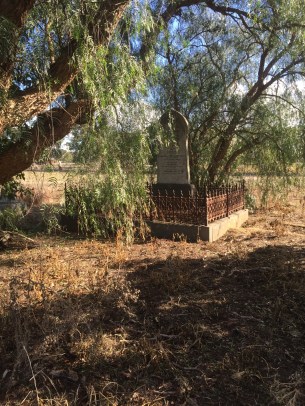
This tiny green area, a family grave sheltered by a very old peppercorn tree is an exception. Just as old people are all too often abandoned in sterile care units, it feels as if the dead who lie here have been abandoned to bake in the summer heat and freeze on extremely frosty mornings.

Perhaps most disturbing was the sign pointing to the Paupers section; a barren field with no markers.

Sadly paupers funerals still exist. They are now known as destitute funerals. In general they are given to people with no known family or assets. They are arranged by the police, if the person dies at home or in a nursing home or by the Social Worker if they die in hospital.

In the situation where someone dies and the family have no ability to pay for funeral expenses it is possible to have the state pay for the funeral. However there is no formal service because a chapel would need to be hired and the priest/minister paid. The grave is not marked so it is difficult to visit in the future.

The paupers section is devoid of statuary with one exception. A stone marking the life of a man who loved fishing lies here.


Unknown Goldfields Miners Grave

‘Since Saturday morning, the scene (on the goldfields) has greatly changed – then a tent would be seen here and there, but now they are becoming inconveniently crowded … On Saturday, dozens were arriving at a time; on Sunday, hundreds; Monday and Tuesday, one continuous line of new arrivals.’
Argus, 8 November 1851

KALIMNA PARK is a bushland reserve on the north eastern outskirts of Castlemaine comprising 175 ha. During the gold rush the area was almost totally denuded and the ground turned over. In time, coppice regrowth has produced a box-ironbark woodland with a characteristic ecosystem of plants, birds and less visible wildlife.

Gold miners often led an itinerant life, following rushes from lead to lead, so tracking their movements can be difficult. In a remote part of this reserve lies the grave of the unknown miner dating back to the gold rush (circa 1850s). I certainly needed my local guide to find this grave, tucked in a remote corner of the park. It is hard to imagine what life was like for this miner seeking gold in what was a remote part at this time. If this hapless miner made his fortune it didn’t bring him any glory! More sadly the gold rush proved to be a second wave of dispossession for the Dja Dja Warrung people. Already marginalised by the first white settlement, the discovery of gold destroyed vast tracts of land and much of their traditional way of life.

The destruction of their environment and subsequently their traditional lifestyle was a major cause of grief for the Aboriginal people. Traditional food sources such as berries and plants, as well as the native animals they depended upon for meat were all destroyed as the Europeans cleared land and stripped huge areas of timber for their own needs.

Was She Robert Burns Granddaughter?

And fare thee well, my only Luve
And fare thee well, a while!
And I will come again, my Luve,
Tho’ it were ten thousand mile.
Robert Burns

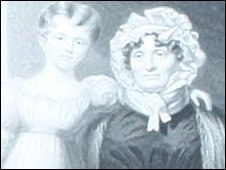
Portrait of Jean Armour and Sarah Burns aged 9

Robert Burns, the celebrated Scottish poet, had 12 children by four women – nine by his wife Jean Armour. Seven of his children were illegitimate, including the first four by Jean Armour, legitimised by their parent’s marriage in 1788. Of Jean’s children, six died young and another, William, had no children.

On a tombstone, in the Castlemaine Cemetery, it is purported this is the place where Sarah Burns, the granddaughter of Robert Burns, lies. No doubt after talking to the Castlemaine Historic Society a local Castlemaine establishment claims that Andrew Campbell built the place as a private residence and that in 1883 he married Sara Burns Thomspon (granddaughter of the celebrated Scottish poet Robert Burns).

I am not disputing this BUT after a rudimentary online search…. A portrait features the poet’s wife, Jean Amour, alongside their beloved granddaughter Sarah. Sarah was nine at the time this portrait was done. According to a Scottish geneologist Sarah Elizabeth Maitland Tombs Burns (1821-1909) was the daughter of their fourth son James Glencairn Burns (1794-1865).

This tombstone says Sarah died in 1885! Perhaps someone, out there can clarify if the woman who lies here really was the granddaughter of the Robert Burns and Jean Armour.

May They Have Found Peace

And when great souls die,
after a period peace blooms
Maya Angelou


On a quiet country back road, near the Newstead General Cemetery, lie two burial markers of interest. One is simply called Chinese Ground.

Chinese gold digger starting for work, circa 1860s. Image courtesy of State Library of Queensland: 60526 .

The Chinese were not welcome on the Australian goldfields. They were thorough workers, often picking meticulously through the discarded tailings or abandoned mines of other diggers. They were viewed with suspicion as few spoke English, and they were regarded as idol-worshippers. Chinese mining methods used more water than European methods, and such practices were not appreciated in a country known for its heat and droughts. Furthermore, few of them traded their gold in the towns, preferring to store it up and return to China with their wealth. The colony of Victoria was the first to introduce Anti-Chinese immigration legislation, imposing a poll tax of £10 per head for each Chinese person arriving in Victorian ports in 1855. Within a few years all other colonial governments had enacted similar laws to restrict the number of people from China entering the colonies. This did not stop the Chinese from arriving in droves and spreading out to goldfields in New South Wales and Victoria.

Tensions came to a head on 30 June 1861 in NSW at Lambing Flat. It is estimated that around 3 000 European diggers banded together in a rowdy gang called a “roll up” and, armed with picks, whips, knives, sticks and anything that could be used as a weapon, converged on the Chinese camp. Chinese tents and equipment were destroyed, gold plundered, and dozens of the men themselves had their pigtails, or ‘queues’, cut off – a matter of great dishonour for them – or worse, they were scalped. An unknown number of Chinese were murdered: although the official death toll for Chinese was given as two, eyewitness accounts suggest between 30 and 40 were killed, and several hundred more injured.

Given that an angry group of European and American miners met in Bendigo in 1854 and declared that a “general and unanimous rising should take place… for the purpose of driving the Chinese off the goldfield” it is not hard to imagine that the Chinese here in this region suffered similarly.

The other stone, not far from the isolated Catholic Ground is inscribed with the words “A tribute to those who lay beneath may they have found peace”. After substantial rainfall this part of the world is truly beautiful. With only the sound of nearby grazing sheep I think it is a good place to lie and rest.

Tonight I Write the Saddest Lines

Tonight I can write the saddest lines.
To think that I do not have her. To feel that I have lost her.
Pablo Neruda

Annie and Henry Clifton
The two young children who lie here, Annie and Henry Clifton, died in a fire in Spring Gully.

What are the saddest lines?  Neruda expresses the grief of lost love! If you believe the Weekly Times the story of the Daylesford lost boys is one of the saddest stories in Australian History. According to this article it was “one of those small-town tragedies which left scars so deep they will never be completely healed”

Clearly we can dispute what represents the saddest stories in Australian history! Collectively we could compile quite a list!

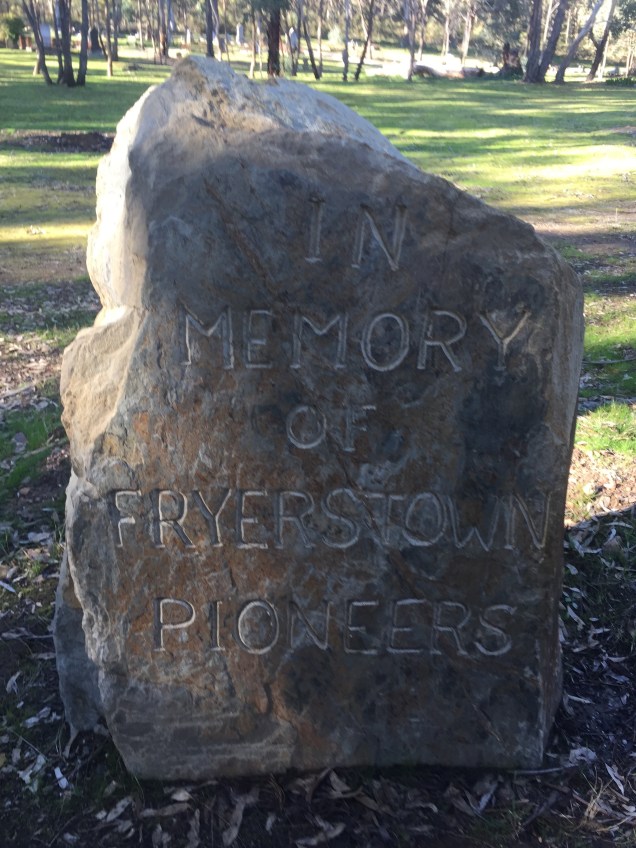
In memory of Fryerstown Pioneers

Today I visited the Fryerstown Cemetery and a lonely grave caught my eye. I stumbled upon the grave of Annie and Henry Clifton! If my internet search is any indication, it would seem that nothing has been written about these children who died tragically in a fire in Spring Gully. They now lie, quite alone, in an isolated, yet beautiful, part of the beautiful Fryerstown Cemetery. I am sure their deaths left deep scars in the community. The Pennyweight Cemetery also bears witness to deep grief.

Geological Lesson in Castlemaine


“This upward facing fold, called an anticline, is a nice example of how the gold-bearing strata in the Victorian goldfields are folded.

The curved stratum, about 50 cm thick, is composed of sandstone and interpreted to have been deposited as a turbidite—an underwater sediment-rich, turbulence deposit. This particular one involved a lot of sand and would have covered a large area.

These turbidites were deposited as the waters of Noah’s Flood were rising, during the Ascending phase of the Flood. It’s likely they were deposited one after the other in quick succession, and all folded soon afterwards, within days or weeks, based on the timing of the sequence of events that took place during the Flood, as documented in Genesis 6 to 9.” Source: Biblicalgeology Blog

Get some play dough out and take the kiddies, or go by yourself, to the Anticlinal Fold in Lyttleton Street for a geology lesson. Take the time to see the local area more deeply. Check out some of the wonders of geology. Make sure to take along art supplies and introduce the whole idea of an art sketch book at the same time.

Mixing with Trees

“A forest is much more than what you see,” says ecologist Suzanne Simard. Her 30 years of research in Canadian forests have led to an astounding discovery — trees talk, often and over vast distances. Learn more about the harmonious yet complicated social lives of trees and prepare to see the natural world with new eyes

Clearly Enid Blyton’s ‘Magic Faraway Tree’ changed me forever. I loved the enchantment of it all. When I was teaching I often used the metaphor of tree roots, particularly with younger students, to convey the notion of drawing from deep within. In writing sessions I have people sit outside with a tree for at least half an hour, amble down amongst the roots and write or draw stream of consciousness thoughts.

There is much to learned about creativity, resilience and self healing from trees! Trees are super co-operators! Gather together the art and writing supplies and get out amid a stand of trees. Check out the Golden Seed Grove for some inspiration. View the Tree of Contemplative practice; meditate by sitting in the arms of a tree! Go out and take the time to listen to what the trees have to tell you.

Resolve to take action to protect these special tree people! Draw attention to the need to save old growth forest and promote regeneration.

In this international bestseller, forester and author Peter Wohlleben convincingly makes the case that, yes, the forest is a social network. He draws on groundbreaking scientific discoveries to describe how trees are like human families- tree parents live together with their children, communicate with them, support them as they grow, share nutrients with those who are sick or struggling, and even warn each other of impending dangers. Wohlleben also shares his deep love of woods and forests, explaining the amazing processes of life, death, and regeneration he has observed in his woodland. After you have read The Hidden Life of Trees, a walk in the woods will never be the same again.

Learn about the astonishing way trees communicate.

Spring is Coming

Tolstoy wrote in Anna Karenina that “spring is the time of plans and projects.” With  the passing of equinox, July inspires us to seriously lift our game. Slow, cosy winter days are replaced with big plans for action.  There are many  spots to find little signs that Spring is coming. Here, in July, in the Southern Hemisphere, on a particularly bleak wintery day, it is reassuring to go into my private backyard woodland and note that unlike in Westeros, spring really is coming.


Who Castlemaine Remembers

“The past does not lie down and decay like a dead animal. It waits for you to find it again and again.”
“The Gilda Stories” ~Jewelle Gomez

This map depicting the journey Burke and Wills is a key part of the monument in Castlemaine

At the time when I was running the Soul Food Cafe I created a number of features which are stored in the Box of Wonderment. One was The Dig Tree which examined the fated journey of Burke and Wills and explored what the creative writer or artist could learn from their expedition.

My great grandfather, George Chale Watson, took a great interest in this expedition. He was in Echuca at the time and was inspired to set off on his own journey of exploration after their departure.

Finding myself in Castlemaine I was intrigued to discover that Castlemaine was the first town to decide to build a monument to Burke and Wills. Initially they wanted to bury Burke at the Castlemaine cemetery.

By May 1862, the citizens of Castlemaine had raised £450 for a memorial from public subscription and donations and on the anniversary of Burke’s death, 1 July 1862, a public holiday was declared. A procession of over 2,000, including John King, John Macadam and Frederick Standish, marched from town to a hill to the east of town where a ceremony was performed and a foundation stone laid by the Sheriff of Castlemaine, Richard Colles.

Why Castlemaine? Why the passion and drive to erect this monument? It appears that Burke, who was born in Ireland in 1820, became the Police Superintendent in Castlemaine in 1858, before being appointed to lead the ill-fated Victorian Exploring Expedition which embarked from Melbourne’s Royal Park on August 20, 1860. Their mission was to become the first expedition of Europeans traversing the interior of Australia from south to north. They traversed successfully but that ultimately this venture would cost Burke and his third-in-command Wills their lives on the return leg. Perhaps if they had connected with the owners of the land they crossed they may have survived.

It is fascinating to check out who Castlemaine likes to remember and offers pride of place to. A visit to the local museum gives one perspective of who the town remembers and equally, chooses to forget.

Out at nearby Guildford a memorial has been created for one of their favourite sons, a Castlemaine born footballer, Ron Barassi

At Chewton there is the Monster Meeting Place where the miners rallied. In pride of place, on a hill overlooking the town, a monument costing a small fortune was erected to remember a fated journey and Robert O’Hara Burke, a policeman who is described as being one of Castlemaine. In actual fact he was an immigrant from Ireland and only lived here for a couple of years. At least Senator Lawson who stands in Lyttleton Street had a long association with Castlemaine.

Personally I would like to know more about what the land remembers; what the land looked like before the European invasion. I would like to know more about the lives of the indigenous people who lived here! Who will you remember and how will you remember them?

Things I Love About Castlemaine

Many years ago, in another life, in a parallel universe, I gave my heart and soul to the creation of the Soul Food Cafe. The Creativity Portal was just one major site that featured the work that I was doing.  Facebook completely changed the online environment and the shift that came with it, along with consecutive losses, silenced me. Ten years ago I walked away from everything I had known, including Soul Food. Eventually I found my way to Castlemaine and settled here.

Reinventing oneself takes time. While Waiting for Godot is a place to wait, a place to reconnect with who I am and what I am passionate about. Now it is enough to sow a new wild garden. The ground is fertile here in Castlemaine and I  know that something will grow. It may be nettle or thistles or roses or carrots or oranges on my citrus trees. If my backyard is any indication something will grow. Fertile ground never remains empty. I am reminded to stay earthed and to attend to my growing ground.

Back in the day Betsy Bayers, “Pinballs’ prompted me to promote list writing. I used the Indian War Bonnet as one way to encourage students to make lists of 28 things they loved, hated, were disappointed about etc. In this instance I will use it to record 28 things I love about living in Castlemaine.

28 Things To Love About Castlemaine

  1. Living within walking distance of the centre of town, the Botanic Gardens and the railway station which provides a regular service to the city.
  2. The host of wonderful spots where I can take my dogs walking – many of which are featured in this blog.
  3. The devoted team who work down at the Botanic Gardens. The gardens are a jewel, something Castlemaine is rightly proud of! I particularly love the woodland area beyond the creek.
  4. The sound of football and cricket matches and sporting teams training at the Camp Reserve.
  5. The comforting sound of the Post Office bell ringing. It brings back memories of my late husband and us staying in an English village.
  6. The sound of the old steam train chugging out to Maldon.
  7. Being able to make full use of a wonderfully stocked, welcoming, library.
  8. Having an electrician respond to an SOS call (the sound of the smoke alarm chirping was impacting on my dogs) and came at 5 on a Saturday afternoon.
  9. Having devoted tradespeople restore my home with loving care.
  10. Having a woodland spring up in my backyard within a couple of years of planting!
  11. Warring with the flocks of sulphur created cockatoos who descend upon my trees. They are hooligans but I cannot help but love those life affirming rascals!
  12. The Pennyweight cemetery is the spiritual place I love to visit.
  13. The exhilarating history of this place! Places like Forest Creek Diggings, the Oak Forest and Specimen Gully Road where history changed.
  14. Good quality book shops.
  15. Turning off the highway and knowing I am almost home.
  16. Proximity to diverse places such as Chewton, Fryerstown, Taradale, Guildford, Newstead, Maldon, Daylesford and Harcourt.
  17. The natural beauty of nearby Mt Alexander and Dog Rocks.
  18. Stunning autumns and spectacular springs.
  19. Looking at old Jack Frost while sitting by my fire.
  20. Enjoying the view across town from the Old Castlemaine Gaol.
  21. Getting a coffee from James and sitting on the platform, deep in conversation, with a friend at the Railway Station.
  22. Knowing my neighbours and knowing how supportive they are.
  23. Waking to the sound of so many birds, knowing my beloved ravens are on the watchtower (neighbouring tall trees) and watching a family of birds take turns bathing in the water in the enamel dish on the back deck.
  24. The community garden at Continuing Ed.
  25. Great supportive friends.
  26. The dog walking community.
  27. Entering my drive, parking the car and walking in the front door after being away.
  28. My home! I give thanks every day for finding it, for being brought to Castlemaine!

Germ of Australian Independence

Much is made of the Eureka Stockade, a rebellion that took place in Ballarat. However, 160 years ago, in 1851, 15,000 protesters gathered on the Forest Creek diggings in central Victoria to object to higher gold license fees. This gathering took place at what has come to be known as the Monster Meeting place at Golden Point. While the Eureka Stockade has a place in Australian history many believe that the Monster Meeting actually started the chain of events. Miners became stronger political force and were stronger and stronger in demanding their rights as citizens as well as miners.

Many of us are guilty of taking hard won rights for granted! Few Australians would think to stop and give thanks to these miners who defied establishment and won democratic rights.

Gratitude is the art of receiving gratefully, of showing appreciation for kindness great and small. It is easy to show gratitude when you receive a gift or an obvious benefit and, alas, just as easy to forget to show gratitude for seemingly less personal benefits.

1. Keep a gratitude journal this month. In honour of the people who met here keep a list of things you are grateful for and things worth fighting for.

2. Each time someone does you a favour make it a practice to look them in the eye and thank them.

3. Think of ways to repay those who have made sacrifices that have been beneficial to your lifestyle. How can you give more than you take? What legacy can you leave? What will your footprints be?

Treasure Hunting in Blanket Gully Road

Ochre was the most important painting material used traditionally by Aboriginal people. It is mined from particular sites and is a crumbly to hard rock heavily coloured by iron oxide. The source material was traded extensively across Australia in the past, with some material traveling many hundreds or even thousands of kilometres from where it was mined to where it was used. It comes in a variety of colours from pale yellow to dark reddish-brown.

Follow Blanket Gully Road until it comes to a T intersection and you enter a very different world from the new housing estate, on the outskirts of Campbells Creek, that you pass to get here. This is a corner of the world full of stones, ochres and pigments. It is not the ideal place for the dog or the little people but it is a surreal landscape full of treasure for the artist.

Nature’s Rock Art

In ancient India lived a sculptor renowned for his life-sized statues of elephants. With trunks curled high, tusks thrust forward, thick legs trampling the earth, these carved beasts seemed to trumpet the sky. One day, a king came to see these magnificent works and to commission statuary for his palace. Struck with wonder, he asked the sculptor, “What is the secret of your artistry?”
Eknath Easwaran

The sculptor upon taking measure of the monarch explained the process. Nature is yet to reveal the secret of its artistry. Perhaps she will reveal it to you if you talk to one of these stone people!


While Waiting for Godot promotes contemplative practices. Take the time to check out Contemplative Practices for inspiration.

Leanganook (Mt Alexander) Stone People

Rising 350 metres above the surrounding area, Mount Alexander (Leanganook) Regional Park is a prominent landmark offering magnificent views and a natural forest setting for picnics and bushwalking. It also provides important habitat for several rare or threatened species.

On a bitterly cold winter day the mountain took on a spiritual quality. It was enough to simply check out spots like the camping ground and commune with the stone people. The stone people, as the ancient one’s of this planet have much to teach us.

DawnEagle Summers tells us that “the stone people you find in your travels will tell you about their gifts, if you listen to them. They each bring their own lessons to our lives, whether they are a precious stone, gemstone, or just a piece of tumbled granite out of your driveway.” She says that once you begin to explore their world, you will learn more about them and suggests that we try carrying a few Ancient Ones in our pocket when we go out to face the world, to help your energy, or to learn from them. She says that stones love to talk with us, to help us, and they want others to know that they will share their teachings with us, if we but listen.

I will wait for another day to spend some time at dog rocks listening to those ancient ones and creating art.   The sniffers were not entirely happy to be confined in the car so we did not linger. Happily they did get out briefly, on lead, at the picnic ground.

Try spending meditative time with a stone person and enhance knowledge of indigenous culture by making dreamtime story stones.

As an aside, while googling, I happened upon this wonderful local concept.

Little Habitat Heroes is a group which invites children to become little habitat heroes. The group, based in Castlemaine, aims to plant indigenous species,  reduce erosion and improve biodiversity, encouraging a return of local wildlife. They wish to foster an ongoing stewardship of the site with regular events to maintain and nurture the growing habitat.

I acknowledge the Aboriginal Traditional Owners of this land. Through their cultural traditions and stewardship, Aboriginal people maintain their connection to their ancestral lands and waters. Take the time to check out ‘Set in Stone’ for something about world famous indigenous rock art.

Winter on Mt Franklin (Lalgambook)

Mt Franklin, known as Lalgambook to the Dja Dja Warrung people, is a small volcanic crater that offers ideal place for a picnic set amongst plantings of huge conifers and deciduous trees that create an exotic atmosphere. It offers a fine example of a breached scoria cone. The breach, through which the road now enters the crater, is thought to have been caused by a flow of lava breaking through the crater rim. Lava from Mount Franklin and other volcanoes in the area filled valleys and buried the gold bearing streams that became the renowned ‘deep leads’ of the gold mining era.


Since I walked away from the city and the life I had known, Mount Franklin has become my point of reference. Up close its size belies its presence on the landscape. It continues to be a marker for me!

Inside the crater of this ancient volcano, once described as a hellish place, it was cold and damp. Other than a solitary camper, huddled for warmth over a fire, we had the place to ourselves. No doubt because pagans have a gathering here, and dare to have a good time, rumours abound about witches inhabiting this place. Bollock to such naysayers! Today I found only welcoming nature spirits, beckoning me to come back, telling me that it is now an idyllic place to retreat to and decompress after a build up of minor annoyances.

Dig out the frisbee, pack a picnic, pile the kids in the car and head out for a nature fix. Allow 30 min max to get to Mt Franklin from Castlemaine. And do pop into the nearby Chocolate Mill for a warm hot chocolate and to replenish the stash you hide from those kids!

The Gower School Ruins

I have no particular talent! I am only passionately curious
Einstein

In 1912 the Gowar township was gazetted, but little came of it.

Gowar is a rural locality 7 km south-east of Maldon. It was known as Muckleford North until 1880, but one hundred years later Muckleford North has probably become the name more often used. It is thought that Gowar derived from an Aboriginal word meaning big hill.

There were minor gold rushes at Muckleford but nothing permanent eventuated. The Muckleford Creek, however, was a source of permanent water for agriculture, the nearest such source for Maldon. A school for Gowar was opened in the early 1870s and closed in 1908. The stone ruin remains.

Gowar was described in the 1903 Australian handbook:

Any evidence of the town has long gone! All that remains are these ruins!