Remaining Buoyant

Over 52 weeks I will be learning all about how to live and work creatively. My teachers are Aussie birds and animals. It is week five and the creative force has produced the Pelican to build on the lessons that Australian birds, animals and habitat are initiating.

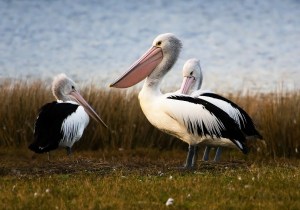
Despite their size pelicans are light and buoyant. They can float like a schooner. A pelican in flight can quite suddenly plummet into the water and then pop up to the surface. Its system of air sacs under the skin makes it unsinkable.

Symbolically this hints at the benefits of buoyancy during tough times. The pelican is teaching that no matter how difficult the creative process may be, no matter how much we may plunge when we are knocked back or our critic’s voice is loud, we can pop back up to the surface.  The Pelican holds the knowledge of how to rise above criticism.

Pelicans, in spite of their lightness, sometimes have a difficult time taking off from the water. Still, they do manage, and again we can see the correspondence to freeing oneself from that which would weigh us down.

The water is a symbol of emotions that may weigh us down. The pelican teaches how not to be overcome by them.

Here are some facts about density and its effect on buoyancy! How can we apply this principle to the creative process? How do you stop your spirits from sinking under the weight of self-doubt and criticism from that inner voice that is quick to pass judgement?

Moola the Pelican

‘As a young boy, I used to sit and watch pelicans for hours. The big graceful birds would sweep down to land on the lagoons near my tribe’s cam, then paddle along, dipping their large bills into the water looking for fish. Pelicans lay sometimes two, sometimes four eggs, and when the little pelicans hatch they leave their nests and spend their time playing and learning with other baby pelicans in a kind of kindergarten. One or two adults look after lots of babies while most of the adults are out looking for food. In a lot of ways they are the Aboriginals, sharing their campsites, and the raising of their young.’
source: Jane Resture Oceania
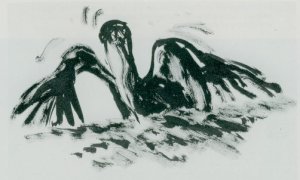
Long ago, in the Dreamtime, there lived a pelican called Moola. In the Dreamtime, pelicans were completely black, and Moola was the blackest and fiercest of them all. he was proud of the way he looked, and each day he would spend hours and hours arranging his feathers, preening and prancing, and grooming himself with his large bill.

When he was quite happy with his appearance, Moola would climb into his bark canoe and paddle around showing off to all the other birds. Moola was very proud of his canoe because he was the only pelican who had one. The other birds would look at Moola and say,

‘Look at Moola, so proud in his canoe.’
‘I wish I had a canoe like Moola’s.’

But Moola was very selfish, he would never let other pelicans ride in his canoe. When they asked, Moola would say,

‘You might fall out, canoes are difficult to paddle.’

Moola knew he looked important, sitting in his canoe, and he didn’t want the other pelicans to look important too. One day there came a huge storm. The rain poured down, soaking all the animals. The old Wombat shivered in his hole, the Kangaroos sheltered under the trees, and still, it rained. It rained so much that the rivers filled and flowed out over the land. The old wombat knew that he would have to leave his cosy hole. As he scrambled out he saw the Kangaroos hopping off towards higher ground. But Moola was delighted. All this water meant that he could paddle his canoe to places he had never been before. It also meant that he could show off to lots of animals who had never seen him before. Big, black, proud Moola, the only pelican with a canoe. As he paddled off, he sang,

‘Munmuckinny, munmuckinny, munmuckinny, munmuckinny.’

He hadn’t rowed very far when he came across a group of Aboriginals stranded on a tiny island. Moola could see that the rising water would soon cover the tiny island. As he came nearer he could see that there were four people, two old women, an old man and a beautiful young girl.

‘Help, please help us. If you don’t save us we will surely drown.’

The young girl, whose name was Mungi, pleaded with Moola,

‘Please save us. You have a canoe and you could take us one at a time.’

Moola stared at her, she was very pretty and young. And, he, Moola the proudest and blackest of all the pelicans didn’t have a woman. Mungi felt uneasy. Why was the big, black bird staring at her like that? She huddled closer to the old woman. They were all very wet, and very frightened. Moola stared at her. If he could get the three old people off the island, then he could come back and take the young girl for himself.

‘I will help you. don’t worry. I can save you with my canoe. I will take you one at a time, and I will take the oldest first.’

Moola collected the older woman and paddled her across the river to where the land was high. He helped her out of the canoe and went back again. He collected the other old woman and returned for the old man. Mungi and the old man sat huddled together on the island. Mungi was frightened. Each time Moola came to the island he stared at her and waved his big yellow bill in the air. When the old man and Moola had gone, Mungi was left sitting all alone. She thought. She was young and very pretty, everyone told her so. Was that why Moola stared at her? She began to cry. Through the rain, she could just see the big, black bird paddling the old man towards the distant shore. she sobbed,

‘At least the old people are saved, but I don’t trust Moola. I am frightened he will steal me to be his woman.’

Moola reached the far bank. She watched the old man climb out of the canoe. Then Moola turned to come back for Mungi. She watched as he paddled towards her. Mungi knew she must escape, if she tried to swim then Moola would only come after her. She must trick him so that she could escape. She had an idea. ‘She quickly slipped the kangaroo-skin rug from around her shoulders, and she wrapped it around a log. Mungi slipped into the water and began to swim to the opposite bank. Moola paddled up to the tiny island. He couldn’t see Mungi. Where was she? He jumped out of his canoe. Mungi was nowhere to be seen. Then Moola saw the kangaroo-skin rug.

‘That Mungi, asleep, when I Moola the most
handsome of all pelicans have come to save her.’

He rushed up to the log and gave it an almighty kick. Pain soared up his leg. He leapt into the air. He had been tricked. Mungi was gone. Moola limped back to his canoe. No one had ever tricked him before. ‘the more he thought of Mungi, the angrier he became.

‘I’ll go back to my camp. I’ll get my spears and I’ll
hunt that Mungi.’

The other pelicans saw Moola coming. He looked quite funny, paddling along with one big, swollen foot dangling out of his canoe. They began to laugh.

‘Look at Moola.’
‘Moola doesn’t look so important now.’
‘Moola, Moola, Bigfoot.’

Their teasing only made Moola angrier. He went to his camp and splashed white war-paint over his body. The white paint made him look very fierce. Moola roared in anger, gathered his spears and started back to his canoe. The older pelicans saw him, all covered in white war-paint. They had never seen anything like it. Pelicans, they said, should not look like this; pelicans were black. They decided to teach Moola a lesson. Flapping their wings, they rushed at him. Wheeling around him, they pecked and flapped, their huge bills plunging into Moola’s black and white feathers. When the old pelicans had finished, they told Moola that he must leave and never return. He was to be banished forever. Although the young pelicans watched in horror as Moola stumbled away, they thought he looked very fierce and proud.

‘If we painted ourselves, then we could look
fierce and proud like Moola.’

So they all rushed off to paint themselves like Moola. Soon all the young pelicans in the cam had covered their black feathers with fierce blotches of white paint. The old pelicans looked amazed. Pelicans should be black. But the young pelicans didn’t listen. They went parading around, admiring their new black and white plumage.

‘We look so fierce.’
We look so proud.’
‘We all look as fierce and as proud as Moola.’

And they have stayed that way ever since. And that is why, today, if you see pelicans on a lagoon or Billabong, you will see that they are black with white patches, just as Moola was, long ago in the Dreamtime.

source: Jane Resture Oceania
Memoir Writing with Possum

Over 52 weeks I will be learning all about how to live and work creatively. My teachers are Aussie birds and animals. It is week four and the creative force has produced the Possum to build on the lessons that Australian birds, animals and habitat are initiating.

KMN-112-SFW - BW2Janganpa jukurrpa (Possum) travels all over Warlpiri country. Janganpa are animals that often nest in hollows of white gum trees (Wapunungku).

This story comes from a big hill called Mawurrji west of Yuendumu and north of Pikilyi (Vaughan Spring).

The “E” shape figures are possum tracks and wavy lines are the trail their tails left on the ground. The concentric circles are the trees in which the possums live. Men and women would go at night for Janganpa hunting. Source: POSSUM DREAMING (JANGANPA JUKURRPA)

Possum is calling upon us to draw a map of the paths we have walked, marking where we have left our track marks. This is a great way to prepare for memoir writing!

You might use the Hiss-tory Snake concept as a way of tackling this.

Exchange Freely

Over 52 weeks I will be learning all about how to live and work creatively. My teachers are Aussie birds and animals. It is week four and the creative force has produced the Possum to build on the lessons that Australian birds, animals and habitat are initiating.

The Djargurd Wurrong possum skin cloak was worn by Gunditjmara Elder Ivan Couzens at the Opening Ceremony of the 2006 Melbourne Commonwealth Games. The cloak was made by Vicki Couzens and Yarran, Jarrah, Marlee, Niyoka and Kirrae Bundle. Gunditjmara, Western District of Victoria. River people.

A dreaming story tells of a confrontation between the Rock Wallaby Men from Port Agusta and the northern Possum Men. The Possum Men were conducting important ceremonies when the Rock Wallabies burst in and a fight broke out. Eventually, the two sides called an end to the fighting and agreed to exchange the important ceremonial knowledge. They established a big corroboree camp and the country surrounding was known as good possum country before the arrival of the white settlers. In fact, Aboriginal law completely protects some of these sites from hunting, even during drought, in order to ensure the survival of their food species. Unfortunately, possums have almost completely disappeared from this region although they are still very important in the dreaming songs and rituals performed today.
Source

Possum has come to remind us that no one can own the stars; that the creative force is responsive when we share and take active steps to protect the source of creativity.

The Djargurd Wurrong possum skin cloak, worn by Gunditjmara Elder Ivan Couzens at the Opening Ceremony of the 2006 Melbourne Commonwealth Games, is an example of what happens when artistic people work collaboratively, rather than keeping their important ceremonial knowledge to themselves. Elder, Ivan Couzens, and others talk about how the cloak helps Aboriginals understand who they are.

Exploring the photographs of possum skin cloaks that were made to wear at the Commonwealth games, and reading the shared stories may inspire us to find a way to express who we are. There are invaluable templates provided which will help us name aspects of ourselves.

Make sure to freely exchange the process you find works as you do this.


The Advantages of Playing Dead

Over 52 weeks I will be learning all about how to live and work creatively. My teachers are Aussie birds and animals. It is week four and the creative force has produced the Possum to build on the lessons that Australian birds, animals and habitat are initiating.

This morning when I was out with the dogs, Archie alerted us to the fact that there was a possum tucked in the branches of one of the shade trees. It took us a moment to spy the frightened, frozen creature whose bright eyes seemed to be looking far far away. Given the fact that we were anticipating that temperatures would rise to 42c our primary concern was that this creature and its access to water. I have been filling vessels for the bird life at my house but with no tap in sight, there was little we could do.

Possum medicine uses a great deal of strategy. Possums are well-known for one of their tricks. These small animals are amongst a group of animals who have the capacity to play dead when predators are near. This way they trick other, larger animals, that they are dead and then attack them or avoid them after they give up on the hunt. This trick helps possums to survive in often dangerous habitats.

Despite idleness being dammed as slothfulness, as one of the seven deadly sins, inactivity plays a perfect role in human life! When we are idle we are actually keeping up a valuable tradition. There are many advantages to inaction! For a start, immobility conserves energy. A half an hour siesta can ward off coronary disease. Plato tells us that Socrates stood still for nearly 24 hours while ruminating on some particularly intractable problems.

Most people would recoil at the idea of doing this but they would be wise to learn from a possum. Sometimes we need to go into a torpor and not think about anything much. Sometimes we need to rest our brains and replenish, in readiness to receive messages from the creator and enjoy another creative spurt.


Go Coddiwompling

Over 52 weeks I will be learning all about how to live and work creatively. My teachers are Aussie birds and animals. It is week three and the creative force has produced the Musk Lorikeet to build on the lessons that Australian birds, animals and habitat are initiating.

Musk Lorikeets are endemic to (only found in) south-eastern Australia, being widespread in eastern New South Wales, all regions of Victoria and in the south-east of South Australia. They are found in tall, open, dry forest and woodlands, dominated by eucalypts and are usually found in the canopy. They are also seen in suburban areas, parks and street trees. They roost or loaf in tall trees away from their feeding sites.
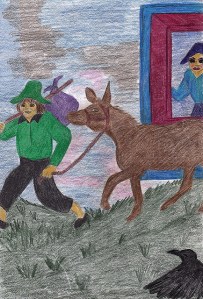
Musk Lorikeets are considered nomadic, following the flowering or fruiting of food trees and they travel widely for food. One might say that the Musk Lorikeet likes to coddiwomple! To Coddiwomple is to travel with no fixed destination. Coddiwomple is just one of at least six words that habitual travellers need.

In 2001 my late husband and I travelled for six months throughout the United Kingdom, Western Europe and Scandinavia with no fixed destination and no forward bookings. Our theory was that if we did not have a destination or a specific address to find we could not get lost. It was an amazing journey and we never slept in the car we had hired. We always found a bed for the night. We didn’t realise it at the time but we were Coddiwompling! To Coddiwomple is To travel in a purposeful manner towards a vague destination. The Coddiwomple family are constantly travelling with no fixed destination. After he died and I sold the family home I had no real destination in mind. I let fate guide me to my current home in Central Victoria.

Believe it or not, you do not have to leave home to coddiwomple. Travellers who joined me in Lemuria had no fixed purpose and no fixed destination. They were virtual travellers who slipped through the portal and let the Enchantress decide where the next adventure lay!

They wandered about in Gypsy Caravans, stopping occasionally at mysterious places like the Well of Remembrance, the Lemurian Abbey, the Isle of Ancestors, Owl Island, the House of the Serpents and Riversleigh Manor. Jo Chapman is a virtual Coddiwompler! She has an imaginary boyfriend who she travels with and they have been to some exotic places.

These days my main coddiwompling is with my little Mazda 3, Akari! She and I love to go out on mystery tours! I let her randomly decide where we are going. Yesterday I went coddiwompling out into the natural habitat of some of the wildlife that also makes its way into my backyard.


Exploring the Expressive Arts

Over 52 weeks I will be learning all about how to live and work creatively. My teachers are Aussie birds and animals. It is week three and the creative force has produced the Musk Lorikeet to build on the lessons that Australian birds, animals and habitat are initiating.

Lorikeets are full of silliness and humour, and they are also inquisitive about their surroundings. These comical birds remind the writer and artist to be expressive and bring colour, humour and light into their work. Lorikeet has drawn me to examine Expressive Arts. Expressive Arts and Art Therapy are creative therapies. The concept of expressive art resonates for me because it honours the process, rather than the final product.
With the arrival of Lorikett I decided that this 52-week project is an expressive art project. I am unashamedly doing this for myself. Committing to 52 weeks is huge and it represents a major shift for me to be genuinely creating FOR MYSELF and FOR THE CREATIVE SPIRIT. I do not actually care if many people engage or follow what I am doing! I am interested in observing and researching the process of being responsive to and feeding the creative spirit.

The web is full of expressive art material. It is a huge field! I was particularly impressed to find the work of Shelley Klammer. On her site, she has an updated list of a popular internet list of art therapy activities which were originally posted by the Nursing School Blog

Lorikeet has suggested that I reprint the section on relaxation, along with a link to Klammer.

Relaxation

Art therapy can be a great way to relax. Consider these exercises if you’re looking to feel a little more laid back.

  1. Paint to music. Letting your creativity flow in response to music is a great way to let out feelings and just relax.
  2. Make a scribble drawing. With this activity, you’ll turn a simple scribble into something beautiful, using line, color and your creativity.
  3. Finger paint. Finger painting isn’t just fun for kids– adults can enjoy it as well. Get your hands messy and really have fun spreading paint around.
  4. Make a mandala. Whether you use the traditional sand or draw one on your own, this meditative symbol can easily help you to loosen up.
  5. Draw with your eyes closed. Not being able to see what you are drawing intensifies fluidity, intuition, touch and sensitivity.
  6. Draw something HUGE. Getting your body involved and moving around can help release emotion as you’re drawing.
  7. Use color blocks. Colors often come with a lot of emotions attached. Choose several paint chips to work with and collage, paint and glue until you’ve created a colorful masterpiece.
  8. Let yourself be free. Don’t allow yourself to judge your work. If you think your paintings are too tight and controlled, this collection of tips and techniques to try should help you work in a looser style.
  9. Only use colors that calm you. Create a drawing or a painting using only colors that you find calming.
  10. Draw in sand. Like a Zen garden, this activity will have you drawing shapes and scenes in the sand, which can be immensely relaxing and a great way to clear your mind.
  11. Make a zentangle. These fun little drawings are a great tool for letting go and helping reduce stress.
  12. Color in a design. Sometimes, the simple act of coloring can be a great way to relax. Find a coloring book or use this mandala for coloring.
  13. Draw outside. Working en plein air can be a fun way to relax and get in touch with nature while you’re working on art.

Perhaps I will get back to drawing a donkey and a raven a day!

Freeing the Caged Bird

Caged Bird By Maya Angelou was first published in her book, “Shaker, Why Don’t You Sing?” in 1983. The poem is a Metaphor illustrating the differences between African-Americans and Whites during the civil rights era. The author, a black who grew up in the South during this era, is expressing her feelings at the discrimination she faced during her life. Her first autobiography published in 1970 is titled, “I Know Why the Caged Bird Sings”

Flying Free by Heather Blakey 2004

Angelou’s poem, Caged Bird, speaks to many who have known what it is to be caged, to have their wings clipped and struggle to leave the cage even when the door is opened. Over the years I have found that many creative people have had their wings clipped by the inner critic.

The inner critic or “critical inner voice” is a concept used in popular psychology and psychotherapy to refer to a subpersonality that judges and demeans a person. The inner critic is usually experienced as an inner voice attacking a person, saying that he or she is bad, wrong, inadequate, worthless, guilty, and so on. It feeds on the words of some teachers, parents and other societal influences.

When I slipped through the portal into the imaginary world of Lemuria I found a world where I could become a bird and float on the back of the Lemurian breezes, dip my golden wings and claim the sky as mine. It was a glorious sense of freedom! More recently I have collected old bird cages and leave them, with doors wide open, scattered throughout the garden.

The free bird leaps
on the back of the wind
and floats downstream
till the current ends
and dips his wings
in the orange sun rays
and dares to claim the sky.

But a bird that stalks
down his narrow cage
can seldom see through
his bars of rage
his wings are clipped and
his feet are tied
so he opens his throat to sing.

The caged bird sings
with fearful trill
of the things unknown
but longed for still
and his tune is heard
on the distant hill for the caged bird
sings of freedom

The free bird thinks of another breeze
and the trade winds soft through the sighing trees
and the fat worms waiting on a dawn-bright lawn
and he names the sky his own.

But a caged bird stands on the grave of dreams
his shadow shouts on a nightmare scream
his wings are clipped and his feet are tied
so he opens his throat to sing

The caged bird sings
with a fearful trill
of things unknown
but longed for still
and his tune is heard
on the distant hill
for the caged bird
sings of freedom.

Source: https://www.familyfriendpoems.com/poem/i-know-why-the-caged-bird-sings-by-maya-angelou

Sing from an Elevated Perch

Over 52 weeks I will be learning all about how to live and work creatively. My teachers are Aussie birds and animals. It is week two and the creative force has produced the Common Blackbird to build on the lessons that the Superb Blue Wren initiated.  

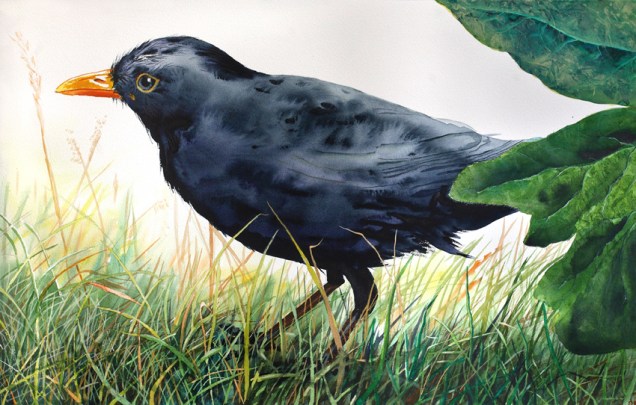
Blackbirds are known for their melodious voice where they sing from high places such as; rooftops, trees and any other elevated perch. They enjoy standing alone singing and catching the attention of others. Today blackbird is asking us to recognize our creative talent. While this may not be singing, there is a talent that each of us should unhesitatingly express. Rather than hiding our Light under a bushel we need to be singing from the rooftops!

Blackbird inspired The Beatles who wrote a song about him:

Blackbird singing in the dead of night
Take these broken wings and learn to fly
All your life

You were only waiting for this moment to arise
Blackbird singing in the dead of night
Take these sunken eyes and learn to see
All your life
You were only waiting for this moment to be free

Blackbird fly Blackbird fly
Into the light of the dark black night

Blackbird fly Blackbird fly
Into the light of the dark black night

Blackbird singing in the dead of night
Take these broken wings and learn to fly
All your life

You were only waiting for this moment to arise

Today Blackbird is reminding us of the need to celebrate our creative talent, build a firm foundation upon which to create and pay close attention to the details. Blackbird is reminding us to listen to the wisdom of Paul McCartney and Maya Angelou’s And Still I Rise.

Blackbird is encouraging us to repair our broken wings, take the moment to arise and share our inspirational gifts with the world.

A participant in one of my writing courses told me that, I had to keep sharing my gift, that I would be selfish to keep the gift hidden under a bushel! Blackbird has encouraged me to arise, puff out my chest and sing, without inhibition, from an elevated space! I am a gifted purveyor of creative stimuli who has shared inspirational ways to promote creative endeavour. I do this by working on projects like this and by putting together an apothecary (a new form of the Soul Food Cafe) for those who wish to feed the creative spirit.

What will you share with the world?