Exchange Freely

Over 52 weeks I will be learning all about how to live and work creatively. My teachers are Aussie birds and animals. It is week four and the creative force has produced the Possum to build on the lessons that Australian birds, animals and habitat are initiating.

The Djargurd Wurrong possum skin cloak was worn by Gunditjmara Elder Ivan Couzens at the Opening Ceremony of the 2006 Melbourne Commonwealth Games. The cloak was made by Vicki Couzens and Yarran, Jarrah, Marlee, Niyoka and Kirrae Bundle. Gunditjmara, Western District of Victoria. River people.

A dreaming story tells of a confrontation between the Rock Wallaby Men from Port Agusta and the northern Possum Men. The Possum Men were conducting important ceremonies when the Rock Wallabies burst in and a fight broke out. Eventually, the two sides called an end to the fighting and agreed to exchange the important ceremonial knowledge. They established a big corroboree camp and the country surrounding was known as good possum country before the arrival of the white settlers. In fact, Aboriginal law completely protects some of these sites from hunting, even during drought, in order to ensure the survival of their food species. Unfortunately, possums have almost completely disappeared from this region although they are still very important in the dreaming songs and rituals performed today.
Source

Possum has come to remind us that no one can own the stars; that the creative force is responsive when we share and take active steps to protect the source of creativity.

The Djargurd Wurrong possum skin cloak, worn by Gunditjmara Elder Ivan Couzens at the Opening Ceremony of the 2006 Melbourne Commonwealth Games, is an example of what happens when artistic people work collaboratively, rather than keeping their important ceremonial knowledge to themselves. Elder, Ivan Couzens, and others talk about how the cloak helps Aboriginals understand who they are.

Exploring the photographs of possum skin cloaks that were made to wear at the Commonwealth games, and reading the shared stories may inspire us to find a way to express who we are. There are invaluable templates provided which will help us name aspects of ourselves.

Make sure to freely exchange the process you find works as you do this.


Building Upon Ancestral Foundations

Over 52 weeks I will be learning all about how to live and work creatively. My teachers are Aussie birds and animals. It is week four and the creative force has produced the Possum to build on the lessons that Australian birds, animals and habitat are initiating.

The tradition of using possum skins for the making of cloaks, waistbands, belts, armbands and headbands was practised by Aboriginal people across eastern Australia.

One of the earliest documented accounts of a possum skin cloak is from Governor Macquarie. In his journal on 10 May 1815 (Bathurst), he recounts that three Wiradjuri warriors, led by Windradyne, visited him and gifts were exchanged. Macquarie gave Windradyne a tomahawk and a piece of yellow cloth; in return, he received a possum skin cloak.

One example of cloak-making from this region is held in the Smithsonian Institute (Washington, DC, USA). Known as the Hunter River Cloak, it was collected during an expedition in the mid 1800s by American explorer Charles Wilkes. It features four rows of six rectangular pelts sewn on the back, edge to edge, with very fine overhand stitching of corded sinew. The fur has been left on and the skin side is completely covered with large diamond-shaped designs made by scraping up a thin layer of the skin so that it stands up in a little curl.3

Traditionally, cloaks were used for ceremonial purposes: in dance, drumming, initiation rites and also in daily life. They were primarily worn as a means of protection from winter conditions, but also used as a shelter from heat and wet weather and to carry babies and small children.

A local example of how valuable the cloaks were in trade is suggested by stories of the Darkinjung nation trading them with inland tribes in exchange for spears and woomeras. In the Dandenong region of Victoria, the trade value of a cloak was said to be worth a greenstone axe. They were also given as peace and marriage offerings.

Possum skin cloaks were created for individuals when they were born and were added to throughout their lives. The intricate designs and ochre decorations were either made by the individual or by others, depending on the design and the purpose for which they were being added.

This practice reminded of a gift that I was given when I visited the  Isle of Ancestors. The Isle of Ancestors is a part of the Lemurian Archipelego, a fantasy world that I created during the hey days of the Soul Food Cafe. It is well worth a visit! Travellers have left rich stories of their meeting with their ancestors at this revered island.

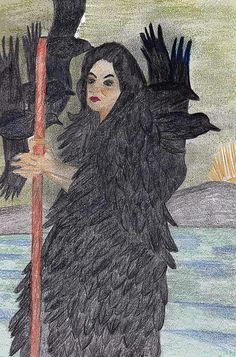
At a point when I was feeling quite low I hitched a ride with the Ferrywoman and visited the sanctuary on the Isle of Ancestors. It was a moving experience as I met all my grandmothers. Before insisting that I return to the world I had come from, they gave me was a cloak filled with raven feathers to wear and provide comfort whenever I felt low.

This cloak held the life stories of the ancestors who walked before me and upon whose shoulders I now stand.

In her iconic book ‘Women Who Run With The Wolves’ Clarissa Pinkola Estes talks extensively about the importance of Soulskins. In her chapter, Homing: Returning to Oneself she talks about how women who have lost their pelt, lose their protections, their warmth, their early warning system and most devastatingly, their instinctual sight.

Possum urges us to see our life as being built upon the foundation of our ancestors; to wrap ourselves within a cloak and find anchorage with our ancestors.

There are many ways that we can honour our ancestors and to actively remember them.

Possum urges the creative to take the time to use some of the ways suggested in the linked articles or to make a metaphorical coat to record the journey. Actively taking tangible steps to honour our ancestors provides a foundation upon which great things can be initiated.

Personally, I found that I viewed my potential differently when I pulled the cloak I had been given out of the cupboard and celebrated wearing it on a daily basis.

The Advantages of Playing Dead

Over 52 weeks I will be learning all about how to live and work creatively. My teachers are Aussie birds and animals. It is week four and the creative force has produced the Possum to build on the lessons that Australian birds, animals and habitat are initiating.

This morning when I was out with the dogs, Archie alerted us to the fact that there was a possum tucked in the branches of one of the shade trees. It took us a moment to spy the frightened, frozen creature whose bright eyes seemed to be looking far far away. Given the fact that we were anticipating that temperatures would rise to 42c our primary concern was that this creature and its access to water. I have been filling vessels for the bird life at my house but with no tap in sight, there was little we could do.

Possum medicine uses a great deal of strategy. Possums are well-known for one of their tricks. These small animals are amongst a group of animals who have the capacity to play dead when predators are near. This way they trick other, larger animals, that they are dead and then attack them or avoid them after they give up on the hunt. This trick helps possums to survive in often dangerous habitats.

Despite idleness being dammed as slothfulness, as one of the seven deadly sins, inactivity plays a perfect role in human life! When we are idle we are actually keeping up a valuable tradition. There are many advantages to inaction! For a start, immobility conserves energy. A half an hour siesta can ward off coronary disease. Plato tells us that Socrates stood still for nearly 24 hours while ruminating on some particularly intractable problems.

Most people would recoil at the idea of doing this but they would be wise to learn from a possum. Sometimes we need to go into a torpor and not think about anything much. Sometimes we need to rest our brains and replenish, in readiness to receive messages from the creator and enjoy another creative spurt.


Rally Your Personal Spirits

Over 52 weeks I will be learning all about how to live and work creatively. My teachers are Aussie birds and animals. It is week three and the creative force has produced the Musk Lorikeet to build on the lessons that Australian birds, animals and habitat are initiating.

In Signs of Love from Heaven Above, Liz Winter explains that our angels and guides are with us all the time if we just care to look. In this article she describes how a lorikeet kissied her back to life and bought her into the present moment. She saw the lorikeet as a sign, a sign of love from Spirit. The Lorikeet seemed to be telling her to look at the beauty around her, look at where she was in that moment. She felt that the bird reminded her that she was not alone.

Loneliness is the elephant in the room for many creative people. Creating can feel lonely even when you are surrounded by others. Paradoxically, it is creating that is a salve to this sense of loneliness.

If you want to be an artist you  need to understand about the difference between aloneness and loneliness. Lorikeet reminds us that we do all have our personal Spirit Allies, ready and waiting to serve us. We only have to rally them for support. Their reward is the joy in our heart. We do not have to feel alone. We do not need to be shy about the Spirit World. We can talk to our guides, unload on them and ask for signs. They are there to help.

Even if it seems to be flitting from one place to another Lorikeet will listen today!

Go Coddiwompling

Over 52 weeks I will be learning all about how to live and work creatively. My teachers are Aussie birds and animals. It is week three and the creative force has produced the Musk Lorikeet to build on the lessons that Australian birds, animals and habitat are initiating.

Musk Lorikeets are endemic to (only found in) south-eastern Australia, being widespread in eastern New South Wales, all regions of Victoria and in the south-east of South Australia. They are found in tall, open, dry forest and woodlands, dominated by eucalypts and are usually found in the canopy. They are also seen in suburban areas, parks and street trees. They roost or loaf in tall trees away from their feeding sites.

Musk Lorikeets are considered nomadic, following the flowering or fruiting of food trees and they travel widely for food. One might say that the Musk Lorikeet likes to coddiwomple! To Coddiwomple is to travel with no fixed destination. Coddiwomple is just one of at least six words that habitual travellers need.

In 2001 my late husband and I travelled for six months throughout the United Kingdom, Western Europe and Scandinavia with no fixed destination and no forward bookings. Our theory was that if we did not have a destination or a specific address to find we could not get lost. It was an amazing journey and we never slept in the car we had hired. We always found a bed for the night. We didn’t realise it at the time but we were Coddiwompling! To Coddiwomple is To travel in a purposeful manner towards a vague destination. The Coddiwomple family are constantly travelling with no fixed destination. After he died and I sold the family home I had no real destination in mind. I let fate guide me to my current home in Central Victoria.

Believe it or not, you do not have to leave home to coddiwomple. Travellers who joined me in Lemuria had no fixed purpose and no fixed destination. They were virtual travellers who slipped through the portal and let the Enchantress decide where the next adventure lay!

They wandered about in Gypsy Caravans, stopping occasionally at mysterious places like the Well of Remembrance, the Lemurian Abbey, the Isle of Ancestors, Owl Island, the House of the Serpents and Riversleigh Manor. Jo Chapman is a virtual Coddiwompler! She has an imaginary boyfriend who she travels with and they have been to some exotic places.

These days my main coddiwompling is with my little Mazda 3, Akari! She and I love to go out on mystery tours! I let her randomly decide where we are going. Yesterday I went coddiwompling out into the natural habitat of some of the wildlife that also makes its way into my backyard.


Exploring the Expressive Arts

Over 52 weeks I will be learning all about how to live and work creatively. My teachers are Aussie birds and animals. It is week three and the creative force has produced the Musk Lorikeet to build on the lessons that Australian birds, animals and habitat are initiating.

Lorikeets are full of silliness and humour, and they are also inquisitive about their surroundings. These comical birds remind the writer and artist to be expressive and bring colour, humour and light into their work. Lorikeet has drawn me to examine Expressive Arts. Expressive Arts and Art Therapy are creative therapies. The concept of expressive art resonates for me because it honours the process, rather than the final product.

With the arrival of Lorikett I decided that this 52-week project is an expressive art project. I am unashamedly doing this for myself. Committing to 52 weeks is huge and it represents a major shift for me to be genuinely creating FOR MYSELF and FOR THE CREATIVE SPIRIT. I do not actually care if many people engage or follow what I am doing! I am interested in observing and researching the process of being responsive to and feeding the creative spirit.

The web is full of expressive art material. It is a huge field! I was particularly impressed to find the work of Shelley Klammer. On her site, she has an updated list of a popular internet list of art therapy activities which were originally posted by the Nursing School Blog

Lorikeet has suggested that I reprint the section on relaxation, along with a link to Klammer.

Relaxation

Art therapy can be a great way to relax. Consider these exercises if you’re looking to feel a little more laid back.

  1. Paint to music. Letting your creativity flow in response to music is a great way to let out feelings and just relax.
  2. Make a scribble drawing. With this activity, you’ll turn a simple scribble into something beautiful, using line, color and your creativity.
  3. Finger paint. Finger painting isn’t just fun for kids– adults can enjoy it as well. Get your hands messy and really have fun spreading paint around.
  4. Make a mandala. Whether you use the traditional sand or draw one on your own, this meditative symbol can easily help you to loosen up.
  5. Draw with your eyes closed. Not being able to see what you are drawing intensifies fluidity, intuition, touch and sensitivity.
  6. Draw something HUGE. Getting your body involved and moving around can help release emotion as you’re drawing.
  7. Use color blocks. Colors often come with a lot of emotions attached. Choose several paint chips to work with and collage, paint and glue until you’ve created a colorful masterpiece.
  8. Let yourself be free. Don’t allow yourself to judge your work. If you think your paintings are too tight and controlled, this collection of tips and techniques to try should help you work in a looser style.
  9. Only use colors that calm you. Create a drawing or a painting using only colors that you find calming.
  10. Draw in sand. Like a Zen garden, this activity will have you drawing shapes and scenes in the sand, which can be immensely relaxing and a great way to clear your mind.
  11. Make a zentangle. These fun little drawings are a great tool for letting go and helping reduce stress.
  12. Color in a design. Sometimes, the simple act of coloring can be a great way to relax. Find a coloring book or use this mandala for coloring.
  13. Draw outside. Working en plein air can be a fun way to relax and get in touch with nature while you’re working on art.

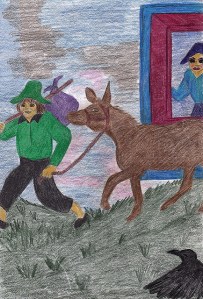
Perhaps I will get back to drawing a donkey and a raven a day!

Create Colourful Portraitures

Over 52 weeks I will be learning all about how to live and work creatively. My teachers are Aussie birds and animals. It is week three and the creative force has produced the Musk Lorikeet to build on the lessons that Australian birds, animals and habitat are initiating.

They talk with their beaks full of blossom
In a cascade of chatter as they sidle
Invisibly through the swaying treetops
They fly in a hurry as if all the gumnuts
Would disappear before they got to them
Geoffrey Dutton

Musk Lorikeets have been feeding on the fruit in my yard, hurling stone fruit onto the roof of the galvanised shed that the fruit tree spreads its branches over. The ground is covered with kernels, hastily discarded as the birds flit off looking for the next treat! These joyful creatures bring brightly coloured plumage and comic antics into my world.

The Rainbow Lorikeet and Musk Lorikeet have inspired rich poetic characterisations, with poets depicting them as gangs of unruly, chattering, aerodynamic, comical bandits. Geoffrey Dutton and Mark O’Connor are just two Australian poets who personify the spirit of these free-ranging, social creatures.

Lorikeets are full of silliness and humour, and they are also inquisitive about their surroundings. They remind the writer and artist to bring colour, humour and light into their work.

Manuel Payno is a writer whose work brought as much joy as a flock of lorikeets. In the translator’s preface, Alan Fluckey describes the small riot that erupted when a ship, carrying copies of  The Bandits from Rio Frio in its cargo, arrived in Mexico. Boxes were hastily opened and copies were sold within minutes as people greedily hustled to get their own personal copy. Book in hand Mexicans sat about in the open air reading to their neighbours! Rainbow chatter filled the air!

Lorikeet and Payno come whirling into my world, reminding me to remind everyone to be exuberant and add colour to their writing; to write and paint about colourful places and colourful characters! Examine the work of Payno closely! Combine this with a copy of The Donkey Inside by Ludwig Bemelmans! Your work will be enriched!

Rainbow Lorikeets
by Mark O’Connor

To feed head-down in an aerial smother of honey and pollen
reassured by a rainbow chatter of siblings
changing tree on impulse
in case python or man is stalking,
reckless till then . . .

A frantic pillaging crew,
crimson-patched pirates screeching in plunder-frenzy,
ignoring the silver-eyes nervously feeding
under those orange scimitars of beak.

The first dozen leave in a second, headlong, a rapid
scatter of downward notes; greedy last tilts his head
and is traumatised by a blank grey-green
widowed of reds and orange.

Before long they’ll circle back.

Shrieks of “Saps up”, “Feed here!”,
churrs of “All’s well, Honey flows”,
screech of “Hawk’s shadow! Watch out!”
mute to the mating thrum
Bill-and-Coo, Tickle-and-Tweek.

Their world is millions of honey-dripping pores.
Free as a child with a million breasts to suckle,
the world’s glands, daytime and night,
at work making sweets for them.

“Comic book bandidos”, but equally
rainbow-motley clowns; with their walk-claws
they tread-cling, wading and stumbling
up loose sprays of blossom
as a lily-trotter walks floating weeds.
They clutch-bunch and jostle on rafts of leaf
buoyed there by bough-spring, then flare out
over forests where the tenth tree in rotation
is an oasis of dripping pompoms.
Their brush-tongues delving and combing
bully honey from bottle-brush florets
or bite them off short,
munching sweet mash.

This desert of unfruiting trees,
deluding the settlers with woody semblances,
is their land of nectar and pollen-bread, antipodean
paradise, where raucous workers thrive.
A good tree gives gallons a day
— but modestly, from flowers as dull as grasses,
pale cream or off-white, blanched foliage.
Birds themselves must play petal;
their stridulous yellows and blues and orange and red
flag out each tree of delights, proclaim the loud shrines
of fermenting, honeyed, winey abundance.

It is said the birds came from dinosaurs.
Rainbow dinosaurs.

Some Colourful Characters Who Populated Lemuria
Heather Blakey 2004 – 10

Magical Healing Voices

Over 52 weeks I will be learning all about how to live and work creatively. My teachers are Aussie birds and animals. It is week two and the creative force has produced the Common Blackbird to build on the lessons that the Superb Blue Wren initiated.  

The Welsh Goddess Rhiannon (Great Queen) was accompanied by magical birds whose enchanted songs could ” awaken the dead and lull the living to sleep”. Tadhg, son of Cian, meets the Divine Cliodna, the most beautiful woman in the world. Her three magical birds heal the sick and wounded with their sweet songs. Rhiannon’s birds charmed the company of Bran into losing track of time, in the Welsh legend The Maginogi. Often three birds appear together in Celtic symbolism, an association with the Triple Goddess. Birds often symbolize the flight of the spirits to the otherworld. They possessed supernatural powers, and throughout Celtic mythology, divine entities frequently shape-shift between human and bird form.

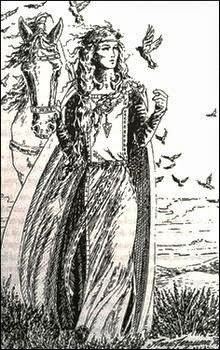
Illustration by Anna-Marie Ferguson
showing Rhiannon,
the Celtic Goddess of Birds and Horses,
who may be associated with the Roman
Goddess Epona. Source

Rhiannon is a Welsh Horse Goddess, her name means White Witch or Great Queen.   She is an inspiring figure to invoke for Poets, Artists, and Singers.    She possesses deep magic and can manifest her dreams and desires for the good of all.  She is a good witch, a Healer.  She travels on a powerful white horse with her mysterious birds that possess healing powers.   These birds are magical, for they are the birds of Sweetest Song and she is their mistress.  Rhiannon’s birds appear in various Celtic symbols in Celtic Art.

Rhíannon is a goddess, the princess submerged in cultural darkness who lies like a shadowy creature in the realms of our dreams waiting to come to life with vigour and passion again.

Rhíannon was as patient as she was beautiful.  She was also extremely courageous.   Rhíannon possessed magnificent singing birds which healed with the magical quality of their voices.

Blackbirds are the bird of both the gateway and the forge. Blackbird calls to us from the gateway between two worlds, urging us to follow a spiritual path or to become more self-aware. he calls to us in the twilight, showing us the path to Otherworldly secrets, pointing out the ways in which we can discover more about our hidden motivations and potential. There are times in life when it is important to concentrate on the outer world and your responsibilities in that world, but there are also times when you must attend to the haunting song of your soul which calls you to a study of spiritual truths, and to an exploration of the inner world through dreams and myths. In heeding Blackbird’s song, you will discover healing and new depths in your soul.

Stop to listen and meditate upon the song of the Common Blackbird! Allow the Common Blackbird to do her magic!

Now let Three Birds of Rhiannon songwriter, Stevie Nicks soothe your creative spirit! Play it again and again! Take words and phrases, write them down, work with the words you glean and see what emerges from the inner world.

Freeing the Caged Bird

Caged Bird By Maya Angelou was first published in her book, “Shaker, Why Don’t You Sing?” in 1983. The poem is a Metaphor illustrating the differences between African-Americans and Whites during the civil rights era. The author, a black who grew up in the South during this era, is expressing her feelings at the discrimination she faced during her life. Her first autobiography published in 1970 is titled, “I Know Why the Caged Bird Sings”

Flying Free by Heather Blakey 2004

Angelou’s poem, Caged Bird, speaks to many who have known what it is to be caged, to have their wings clipped and struggle to leave the cage even when the door is opened. Over the years I have found that many creative people have had their wings clipped by the inner critic.

The inner critic or “critical inner voice” is a concept used in popular psychology and psychotherapy to refer to a subpersonality that judges and demeans a person. The inner critic is usually experienced as an inner voice attacking a person, saying that he or she is bad, wrong, inadequate, worthless, guilty, and so on. It feeds on the words of some teachers, parents and other societal influences.

When I slipped through the portal into the imaginary world of Lemuria I found a world where I could become a bird and float on the back of the Lemurian breezes, dip my golden wings and claim the sky as mine. It was a glorious sense of freedom! More recently I have collected old bird cages and leave them, with doors wide open, scattered throughout the garden.

The free bird leaps
on the back of the wind
and floats downstream
till the current ends
and dips his wings
in the orange sun rays
and dares to claim the sky.

But a bird that stalks
down his narrow cage
can seldom see through
his bars of rage
his wings are clipped and
his feet are tied
so he opens his throat to sing.

The caged bird sings
with fearful trill
of the things unknown
but longed for still
and his tune is heard
on the distant hill for the caged bird
sings of freedom

The free bird thinks of another breeze
and the trade winds soft through the sighing trees
and the fat worms waiting on a dawn-bright lawn
and he names the sky his own.

But a caged bird stands on the grave of dreams
his shadow shouts on a nightmare scream
his wings are clipped and his feet are tied
so he opens his throat to sing

The caged bird sings
with a fearful trill
of things unknown
but longed for still
and his tune is heard
on the distant hill
for the caged bird
sings of freedom.

Source: https://www.familyfriendpoems.com/poem/i-know-why-the-caged-bird-sings-by-maya-angelou

A Foraging We Go

Over 52 weeks I will be learning all about how to live and work creatively. My teachers are Aussie birds and animals. It is week two and the creative force has produced the Common Blackbird to build on the lessons that the Superb Blue Wren initiated.  

The dictionary describes foraging as a “search for food or provisions.”

Essentially, foraging is the purest and simplest of instincts. The natural reaction to hunger is to seek out food, and before the 24-hour convenience of neatly-arranged supermarket aisles, we scoured the countryside for something, anything, that would sustain us.

Not so many years ago, if you left the house with a wicker basket to harvest food, most people would snigger and point you towards the nearest supermarket. Mushrooming? Heaven forbids; the fungi world was fraught with danger. However, enter celebrity chefs like Jamie Oliver! They have enlightened us about the edible delights that can be found on our doorsteps. Now, any chef worth his or her Michelin salt is foraging or sourcing wild food that sings with natural, integral flavours.

♠ Watch the common blackbird foraging! What are twenty things you observe about the art of foraging?

You might head out with a basket and forage for food or, like me, you might adapt the definition of foraging. For my purposes foraging is the search for food or provisions which will feed my creative spirit! I let my fingers do the walking and under the tutorage of the sharp-eyed blackbird, seek out creative stimuli that will further my creative endeavours. Alternatively, I go to charity stores, second-hand collectable places, libraries, bookshops etc and just see what turns up.

After stumbling upon the Curious Origins of Sing a Song of Sixpence  I was intrigued by where examining a simple nursery rhyme might take me. As the writer of this article says, delving into peoples attempts to find meaning in what was probably a jaunty ditty to amuse children, has been a voyage of learning  in so many ways. How else would we learn about the notorious life of Edward Teach, the medieval splendours of entremet, the lacklustre poet laureate Henry Pye and the larger than life shenanigans of Henry the VIII.

Random Acts of Foraging

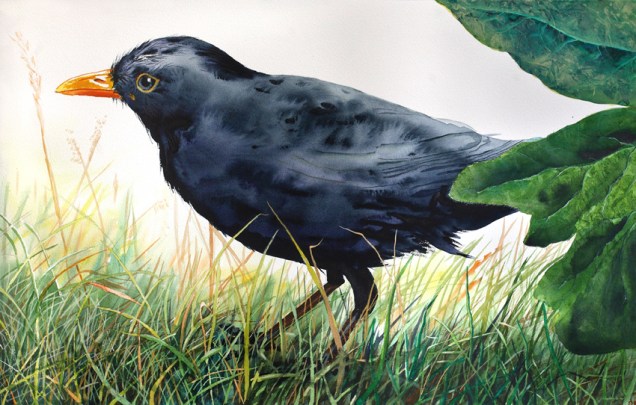
The Irish Blackbird, Turdus merula, is a common, resident bird; the males are solid black with a bright orange beak, and the females tend to be brownish in colour (Irish Birds). They are well-known for their abilities as beautiful songsters, and it is because of this trait that they appear often in the literature. ”The ‘Three Birds of Rhiannon’ [a Celtic goddess and queen] were said to have the ability to sing the dead to life, and the living into a sleep of death”, and these birds were also the “harbingers of the Otherworld, and their singing at Harlech in the tale of Branwen suspends earthly time”.  Considering their talents with a song, it comes as no surprise that the Blackbird is generally seen in the role.  In addition, the blackbird’s importance is consistently seen in the native set of symbols as being one of the “Oldest Animals”, in other words, an animal that has been around since the beginning of time, and has learned much about how the world works. Source

Blackbird Fact Sheet

The Story of the White Blackbird  The White Blackbird” is a charming satire on the literary life of Alfred de Musset’s time, exposing not merely the ease with which popular taste is imposed upon and some current types of literary humbugs, but also the universal tendency to confound mere eccentricity with genius.

Three Little Birds” is a song by Bob Marley and the Wailers. It is the fourth track on side two of their 1977 album Exodus and was released as a single in 1980. The song reached the Top 20 in the UK, peaking at number 17. It is one of Bob Marley’s most popular songs.

This happy, upbeat tune tells the tale of three birds who helped remind Bob Marley that “every little thing is gonna be all right.”  Marley died on 11 May 1981 at Cedars of Lebanon Hospital in Miami (now University of Miami Hospital), aged 36. The spread of melanoma to his lungs and brain caused his death. His final words to his son Ziggy were “Money can’t buy life.” In his lifetime he certainly spread his wings and flew! He leaves a rich legacy

https://youtu.be/6i4co3_Jtjk

♠ What does Blackbird help you find! Where does the treasure take you? Feel free to gloat and tell us about any treasure that you find under a leaf!

Sing from an Elevated Perch

Over 52 weeks I will be learning all about how to live and work creatively. My teachers are Aussie birds and animals. It is week two and the creative force has produced the Common Blackbird to build on the lessons that the Superb Blue Wren initiated.  

Blackbirds are known for their melodious voice where they sing from high places such as; rooftops, trees and any other elevated perch. They enjoy standing alone singing and catching the attention of others. Today blackbird is asking us to recognize our creative talent. While this may not be singing, there is a talent that each of us should unhesitatingly express. Rather than hiding our Light under a bushel we need to be singing from the rooftops!

Blackbird inspired The Beatles who wrote a song about him:

Blackbird singing in the dead of night
Take these broken wings and learn to fly
All your life

You were only waiting for this moment to arise
Blackbird singing in the dead of night
Take these sunken eyes and learn to see
All your life
You were only waiting for this moment to be free

Blackbird fly Blackbird fly
Into the light of the dark black night

Blackbird fly Blackbird fly
Into the light of the dark black night

Blackbird singing in the dead of night
Take these broken wings and learn to fly
All your life

You were only waiting for this moment to arise

Today Blackbird is reminding us of the need to celebrate our creative talent, build a firm foundation upon which to create and pay close attention to the details. Blackbird is reminding us to listen to the wisdom of Paul McCartney and Maya Angelou’s And Still I Rise.

Blackbird is encouraging us to repair our broken wings, take the moment to arise and share our inspirational gifts with the world.

A participant in one of my writing courses told me that, I had to keep sharing my gift, that I would be selfish to keep the gift hidden under a bushel! Blackbird has encouraged me to arise, puff out my chest and sing, without inhibition, from an elevated space! I am a gifted purveyor of creative stimuli who has shared inspirational ways to promote creative endeavour. I do this by working on projects like this and by putting together an apothecary (a new form of the Soul Food Cafe) for those who wish to feed the creative spirit.

What will you share with the world?

Valuing One’s Unique Identity

Over 52 weeks I will be learning all about how to live and work creatively. My teachers are Aussie birds and animals. It is week one and the creative force has produced the Superb Blue Wren to provide some lessons!

“The Arrernte word Awelye, from Central Australia, describes the interrelationship of everything; plant, animal, earth and language. Aboriginal knowledge about plants, animals, non-living things, spirit, economy, aesthetics, kin, responsibility and journeying bind types of information with one another.
In other words, everything informs us about everything else and nothing can be considered in isolation. By contrast, non-indigenous knowledge structures involve hierarchical and increasing separation of information into ever smaller parts for detailed examination. Aboriginal knowledge stems from the practical experience of natural resources. Like all people that live with and close to the land, they have developed an understanding of the interrelationships between ecological functions and broader patterns in climate and geophysical features. Understanding and learning the signals of change is indicative of the depth of knowledge that Aboriginal people have achieved.

Totems are a significant symbol of Aboriginal people’s inextricable link to the land. Aboriginal people gave recognition to the power of the plant and animal spirits by wearing skins and masks of ceremonial paint, and by mimicking, singing praise and dedicating prayers to specific plants and animals.

They painted and engraved them in caves, rock overhangs and on rock platforms, on bark and burial trees and asked Mirrirul4 to guide them to plant and animal foods and to bless the spirit of the plant or animal that was killed. These acts allowed people to remain linked to the plant and animal guides and to accept the power they offer in lessons, in life, and in death. It reminded people that all animals are our sisters, brothers, and cousins and most importantly our teachers and our friends.” Source:  Murni Dhungang Jirrar Living in the Illawarra

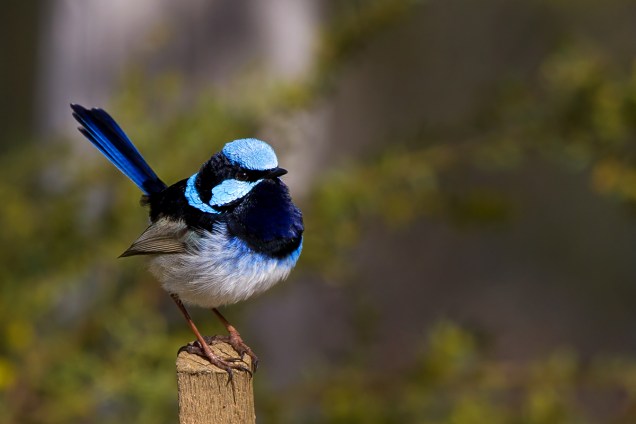
The Ngarrindjeri people of the Murray River and Coorong regions called the Blue Fairy-Wren, waatji pulyeri, meaning “little one of the waatji (lignum) bush”, and the Gunai called it deeydgun, meaning “little bird with long tail”.  Both it and the variegated fairywren were known as muruduwin to the local Eora and Darug inhabitants of the Sydney basin.

This Aboriginal Dreaming story about waatji pulyeri (blue fairy-wren) reminds us that while we are all interconnected we each have unique characteristics. It also cautions the creative of the dangers of engaging in competitions to prove one’s worth! We are reminded that individuality is a very important part of our identity. Blue Wren’s story tells the creative that they do not need to engage in a competition. They only have to be their unique self!


What is your Creative Niche?

Over 52 weeks I will be learning all about how to live and work creatively. My teachers are Aussie birds and animals. It is week one and the creative force has produced the Superb Blue Wren to provide some lessons!

Superb-fairy-wren

Andrew Katsis, who spent two years of a Masters studying the fairy-wren, reveals that there is much more to this striking bird than meets the eye. He explains that they live in cooperative family groups (in which sons – but not daughters – hang around to help raise their younger siblings), learn vocalisations from their mother while still inside the egg, and boast perhaps the highest rate of adultery in the bird kingdom.

One intriguing finding of a Geelong study was that being more exploratory affected a bird’s survival chances. Fast- explorers were less likely to be present in the population a year later, most likely because they had died. The researchers speculated that fast- explorers are perhaps less wary of potential threats and more likely to stray into the sights of predators.

One cannot help but ask why this variation exist at all?  You might think that natural selection would quickly weed out all the fast- explorers? This is a question the research group are working on. One possible explanation is that birds with different personalities facilitate each other by performing different social roles (known as social niche specialisation). Fast- explorers may be filling a separate social niche that achieves equal reproductive fitness despite their shorter lifespan.

Today the fairy-wren encourages us to consider how we work, to consider our creative niche specialisation! Fairy-wren asks us to consider how we pace ourselves? Fast- exploring animals tend to form routines more quickly, and therefore thrive in consistent environments. Slow- exploring animals are better able to respond to changes in their environment, which may be beneficial in a fluctuating habitat.

Take the time to consider your social niche specialisation and the routine that works best for you!

Wild Play – Who Will I Be Today?

I have it on good authority that 12 Fairy Penguins are coming on the twelfth day of Christmas to invite everyone to play.

It is important to remember that we are here to work at living not, as some do, live to work. I sometimes think there is another life I might have lived!

After spending a month, thinking up creative activities as a part of the While Waiting for Godot Advent-ure calendar, I am thinking that perhaps I will take the radical step of doing some of the activities I have suggested.

I am thinking that, while I go on waiting for Godot to reveal what I am supposed to be doing, I will ask the creative force how we should play. We might just find some wild, playful activities!  Anita  Marie Moscoso engaged in some wild play with her family and they all appear to have had a lot of fun!

One day at a time! To begin, all I need to do is decide who I will be today! How will the creative spirit and I play today?

After trawling my Flickr file I am reminded that I have many aspects! I have been many people! Will I be a pirate, a belly dancer, a traveller arriving at the City of Ladies or a Ferry Woman preparing to take people to the Isle of Ancestors? Will I read my tarot or slip through a portal, travel the Dak road and find a secret cottage to stay in?

Decisions! Decisions! Ellen Uma Bard who goes Wherever the Wind Takes Her offers 99 suggestions about how to play. How will you play today? Who will your be?

Tarot Story Starters

Sometimes, when I need fuel injected creativity, I turn to a Tarot deck. This deck is far from complete, but there are some stories lying behind my version of the Tarot. 2010 was a traumatic year for me so there were many swords appearing in my drawings.
Heather Blakey Pencil Drawings 2010

Sensory Healing Garden

According to the definition provided by Hussein, a sensory garden is a garden where all components are carefully designed to provide maximum sensory stimulation (2011). The aim of these gardens is to heighten our awareness of our interaction with nature through our senses. This definition of a sensory garden encompasses awareness of all aspects of the garden, both vegetative and hardscape elements. The hardscape elements to be included in therapeutic gardens, including sensory gardens, are as important as the vegetative elements because they become an integral part of the overall experience. For example, paths, walls, seating and signage all allow access, inclusivity and interactivity within the garden.
From Therapeutic Gardens

Since moving to this home in 2010 I have worked intuitively, using my senses, to create two quite distinct gardens. The front garden has elements of what Nana would have planted in her 1960’s garden while the exposed, harsh backyard has been transformed into a woodland that attracts a rich variety of birdlife.

Stones Record Family Losses

In the first few years of the colony, mortality was very high, but the common childhood infections were absent until the 1830s. From the 1880s, there was a sustained decline in mortality from communicable diseases, and therefore in aggregate mortality, while maternal mortality remained high.

Some details included with photos.

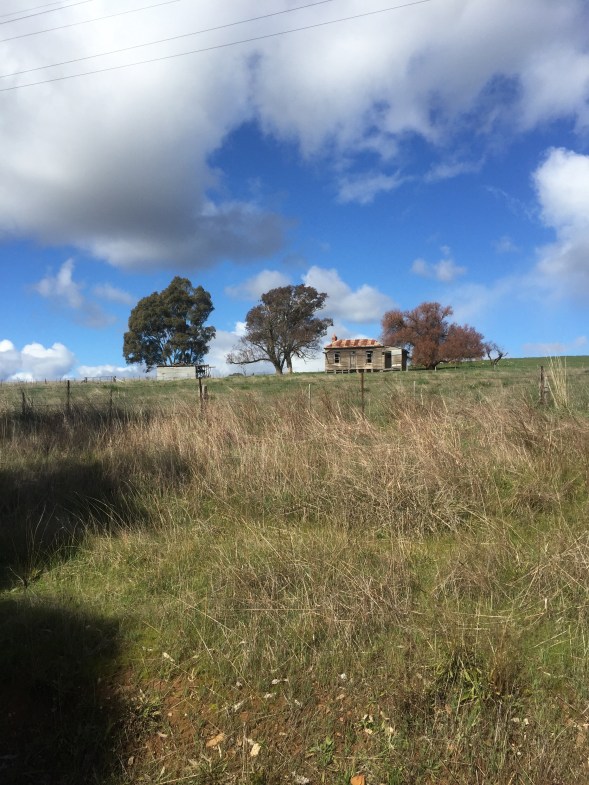
Faded Central Victorian Beauty

“Elegance is the only beauty that never fades…. -Audrey Hepburn

I beg to differ…
there are many beauties…..
such as…

Fading Victoria

Honouring The Pioneers

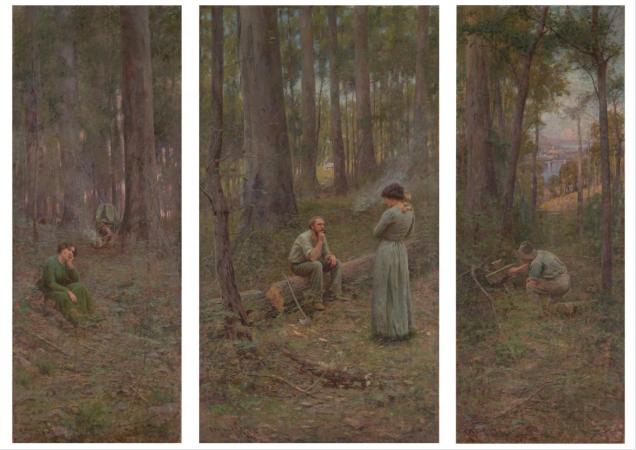
Henry Lawson’s The Drover’s Wife is an Australian classic that depicts life for the early Australian pioneers. McCubbin’s monumental painting The pioneer reflects the self-conscious nationalism of the years immediately following Federation. Each panel is ‘read’ to link the progress of toil on this land across time.

The first panel shows a pioneering couple in their new bush environment: the man is lighting a fire to boil the billy, while the woman contemplates their future life. The second panel shows the couple several years later: the woman holds a baby, land has been cleared and a small house has been built. In the final panel a bushman discovers a grave, and in the background a city begins to emerge. It is uncertain who has died and whether the male figure is the pioneer, his son or a stranger. By presenting his painting across three panels – the triptych format for traditional religious art – McCubbin elevated the status of the pioneer within Australian art history.

The pioneers who came to Central Victoria are honoured in various ways. Less marks the lives of those people who lived on the land that was not actually empty when Europeans first arrived.

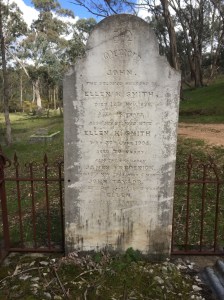
This installation, at the Vaughan Cemetery, was gifted by the artist in memory of her pioneering ancestors who, like couple, sacrificed so much and contributed to shaping the township of Vaughan. She also pays respect to the Dja Daj Warring, the first people who lived here.

Cemetery Exploring With Akari

Workers and players have earned their repose.
Soon on their names all in vain we shall call,
For even the grandest old landmarks must fall.
Just a warm hand-clasp ere one disappears—
These are the last of the old pioneers.
John Sandes

Turn off the Castlemaine to Maldon road onto the gravel Sandy Creek road and follow the old Cobb & Co route, past the old hotel, where they stopped for a break and drive on  towards Welshman’s Reef through Box-ironbark country.

Welshmans Reef is a former gold mining town 15 km west of Castlemaine and 110 km north-west of Melbourne. The name presumably came about from a Welshman discovering the gold-bearing reef: there were numerous Welsh and Methodist settlers at neighbouring townships such as Fryerstown and Vaughan.

West of Welshmans Reef there were the Loddon flats, which enabled miners to diversify into farming. A school was opened in 1877. The place was seldom more than a hamlet and its peak pre-twenty-first-century census population of 215 persons was in 1915. In 1956 the Cairn Curran Reservoir was completed, inundating much of the river flats.

As you approach the hamlet a sign points to the old Sandy Creek Cemetery, a cemetery that was closed in 1956. Many pioneers who came seeking gold lie here. Noting our arrival a large mob of kangaroos took off, bounding across the creek.

The sight of so many small white, numbered markers, combined with the fact that there were only a few headstones, took my breath away. Memorials placed by descendants revealed that this  is a place to honour the pioneers who came here.

The Perfect Hideaway

Now that I am the age I am I totally get why my parents enjoyed their Sunday drives. Mum would fill the cake tin, make a flask of tea and out we would go. Mum and Dad regularly explored the rabbit warren of our immediate world in Gippsland. Now, like them, I have become addicted to wandering, just having a look see. You never know what you will see if you just open your eyes and look. You never know what you will conjure unless  you are prepared to dream.


Even though MIDNITE was seventeen, he wasn’t very bright. So when his father died, his five animal friends decided to look after him. Khat, the Siamese, suggested he became a bushranger, and his horse, Red Ned, offered to help. But it wasn’t very easy, especially when Trooper O’Grady kept putting him in prison.

So it was just as well that in the end he found GOLD!

Midnite, by Randolph Stow, is a brilliant good-humoured and amusing history of the exploits of Captain Midnite and his five good animal friends who lived in a hidden valley!

Australian Bushrangers like Captain Midnite, or Captain Starlight, as depicted in the classic Robbery Under Arms were fond of hiding places in out of the way valleys like this one beyond Yandoit. I am not likely to take up bush ranging but if I found some GOLD I would look for a place, tucked in a very private little valley, just like this, and create an art sanctuary for wandering creatives.

The Etcher’s Secret

Last night, or maybe it was early this morning, Jack Frost, the master etcher, made an ice etching for me, leaving it, for me to find, in a metal bucket on my deck. “All who see it are astounded and think it must be the work of spirits”. In awe I  asked the master etcher “What is your secret?”

The Woodcarver

Khing, the master carver, made a bell stand
Of precious wood. When it was finished,
All who saw it were astounded. They said it must be
The work of spirits.
The Prince of Lu said to the master carver:
“What is your secret?”

Khing replied: “I am only a workman:
I have no secret. There is only this:
When I began to think about the work you commanded
I guarded my spirit, did not expend it
On trifles, that were not to the point.
I fasted in order to set
My heart at rest.

After three days fasting,
I had forgotten gain and success.
After five days
I had forgotten praise or criticism.
After seven days
I had forgotten my body
With all its limbs.

“By this time all thought of your Highness
And of the court had faded away.
All that might distract me from the work
Had vanished.
I was collected in the single thought
Of the bell stand.

“Then I went to the forest
To see the trees in their own natural state.
When the right tree appeared before my eyes,
The bell stand also appeared in it, clearly, beyond doubt.
All I had to do was to put forth my hand
and begin.

“If I had not met this particular tree
There would have been
No bell stand at all.

“What happened?
My own collected thought
Encountered the hidden potential in the wood;
From this live encounter came the work
Which you ascribe to the spirits.”

– Chuang Tzu
from The Way of Chuang Tzu by Thomas Merton

The Past Dwells Here

An entire past comes to dwell here!
Gaston Bachelard ‘Poetics of Space’

In the summer of 2011, on the Ardnamurchan Peninsula on Scotland’s west coast, excavations revealed the only known Viking boat burial to be excavated on the British mainland in modern times. The vessel survived in the form of more than 200 rivets, many in their original location, and indicated a small clinker boat. It contained a sword, an axe, a spear, a ladle, an Irish bronze ring-pin and the bronze rim of a drinking horn. These items indicate that it was a remarkably rich Viking boat burial of a warrior. Positioned beside the warship Roskilde 6, the Ardnamurchan boat burial represents the final journey of a Viking warrior, sailing into the afterlife. Source: A History of the Viking World

An African proverb says that ‘when an old man dies, a library burns to the ground’.

Here at the Glenlyon Cemetery there may not be a rich treasury of artefacts, but rich memories lie here. One grave holds an image, perhaps created by the lad who died, forever young, who is mourned by his family.

Another tombstone in the Sutton Grange Cemetery includes images of a young lad skiing. A photo of his beloved dog watches over him. Nearby the crystals, of ‘a woman with a gentle soul’ are mingled among the stones of a beautiful modern memorial.

It is may not be as fashionable to spend time in cemeteries now but a graveyard can be  a great place to explore local history and genealogy, take a peaceful seasonal walk and contemplate the pasts that lie there.

It is also a great place to meditate, make art and enjoy a flask of coffee!

The Humblest Dwelling Has Beauty

If we look at it intimately, the humblest dwelling has beauty!

This house, as I see it, is a sort of airy structure that moves about on the breath of time. It really is open to the breath of another time.
Bachelard ‘Poetics of Space’

Interpreting Spaces

In an age of so much homogenised space, so much shoddy, cramped, dimly lit, low ceilinged space, these resting places offer a fresh way of interpreting and understanding space. In an era suffused by television and video games, fluorescent lighting and plastic floors, air conditioning and badly built houses these memorials demonstrate the poetry of space and love.

from forward to ‘The Poetics of Space’ written by John R Stilgoe


If I were asked to name the chief benefit of the house, I should say the house shelters daydreaming, the house protects the dreamer, the house allows one to dream in peace.

All inhabited space bears the essence of home.
Gaston Bachelard